On Top Down Under
2002
No user ratings available yet
Representation score: 5.3 out of 10
Representation Score
Fair
1973
RDirector
Mort Heilig
Runtime
100 minutes
Average Rating
No ratings yetNew Showbiz Analysis
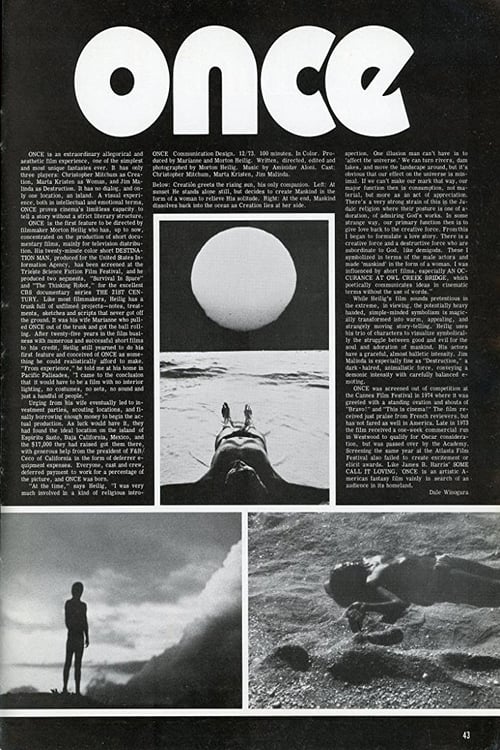
Mort Heilig’s *Once* is an avant-garde experiment that replaces traditional social commentary with cosmic allegory. By using silence and primal imagery, the film rejects the linguistic and social hierarchies common in 1970s cinema. While the film’s deconstruction of storytelling methods aligns it with a non-conformist tradition, it lacks explicit markers of diverse identities. The representation is defined more by what is absent—such as specific identities or social signifiers—than by what is present. Ultimately, the work functions as a subjective, philosophical inquiry. It trades specific demographic representation for a universalist, albeit ambiguous, exploration of humanity and creation.
Category Breakdown
The film presents an allegorical love story between Creation and Humanity, offering a fluid interpretation of intimacy. While the characters' silent performances and lack of modern dialogue avoid assumptions about heterosexual relationships, there is no explicit storyline focusing on LGBTQ+ identities.
The film uses primal archetypes and strips away modern social signifiers, bypassing traditional gender roles. It disrupts standard hierarchies, but it remains unclear if this challenges or simply avoids gendered power structures.
The setting and primordial costumes suggest a universalist approach to the story of Creation. However, the film does not provide specific details about the racial composition of the cast.
The narrative prioritizes abstract philosophical inquiry over traditional Western or Christian moral frameworks. This focus on cosmic forces suggests a move toward secularism and a rejection of organized social institutions.
The film provides no evidence of characters with physical or neurodivergent disabilities.
Present on Screen
Limited or Absent
Official Synopsis
Filmed on a California beach, this arty outing features loin-cloth wearing actors silently telling the allegorical love story between Creation and Humanity on a lonely California beach.
2002
1970
1970
1973
1967

2016
1962
1973
No reviews yet. Be the first to share your thoughts on this movie!
Use the rating form above to leave a star rating and optional review.