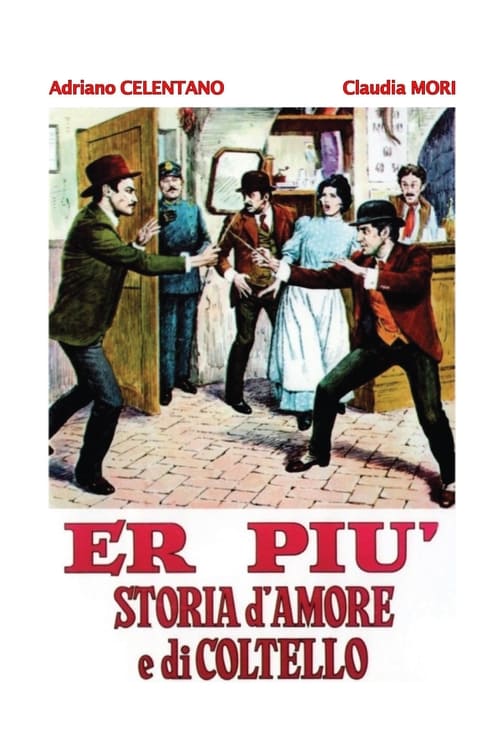
The Story of Romance and Knife
1971
No user ratings available yet
Representation score: 3.1 out of 10

Representation Score
Fair
1985
Director
Pupi Avati
Runtime
94 minutes
Average Rating
No ratings yetNew Showbiz Analysis
Pupi Avati’s film primarily explores social stratification and the pursuit of upward mobility. The narrative tension stems from the interaction between class boundaries, particularly a working-class protagonist navigating a bourgeois environment. The film excels in its social commentary rather than demographic diversity. By centering a protagonist whose social status challenges the stability of the upper class, it deconstructs class-based structures. However, the film remains constrained by the demographic norms of its era. It lacks explicit representation of racial, ethnic, or LGBTQ+ identities, focusing instead on the dynamics between provincial life and evolving social hierarchies.
Category Breakdown
The film centers on a heterosexual relationship between a baker and a bourgeois woman. Although it doesn't explicitly depict non-cisgender identities, its focus on social outsiders may hint at characters outside traditional norms.
The story shifts away from traditional masculine dominance by highlighting the emotional journey of the male protagonist. It explores the social precariousness and vulnerability of his position, moving away from typical male-centric narratives.
Reflecting the demographic homogeneity of mid-1980s Italy, the film focuses on class distinctions rather than ethnic diversity. It adheres to the casting norms of its time, which were predominantly white and middle-class.
The story critiques rigid bourgeois institutions and class structures. It examines the tension between social climbing and the varying realities of different social classes.
The film does not include characters with visible or invisible disabilities as central plot devices or narrative drivers.
Present on Screen
Limited or Absent
Official Synopsis
The endearing efforts of a divorced, simple baker to capture the attentions of a bourgeois society woman.
1971

1986

1951

1965
1967

1974

2011
1967
No reviews yet. Be the first to share your thoughts on this movie!
Use the rating form above to leave a star rating and optional review.