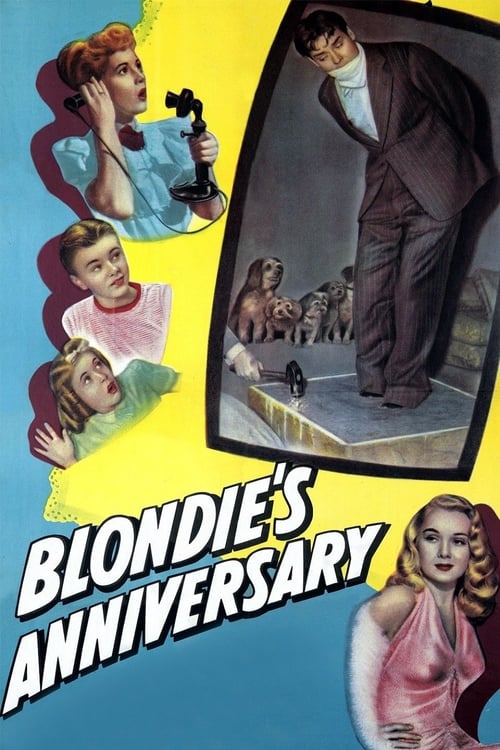
Blondie's Anniversary
1947
No user ratings available yet
Representation score: 1.8 out of 10

Representation Score
Minimal
1947
NRDirector
Abby Berlin
Runtime
67 minutes
Average Rating
No ratings yetNew Showbiz Analysis
The film opens on the Bumsteads’ cramped, cluttered apartment, a visual shorthand for their working-class status that immediately contrasts with the polished, spacious world of the Breckenridges. This domestic farce sells a specific vision of 1947 stability: the "common man" is happy in his station, provided he has a loving wife and a secure home. The camera lingers on Blondie’s exasperated yet affectionate expressions, positioning her as the moral center who keeps the family afloat while Dagwood, the perpetual everyman, stumbles through his own anxiety. The narrative’s argument is tested by Dagwood’s brief flirtation with social mobility. When he mistakes a modest raise for a fortune, the film uses this error to explore class boundaries, but it ultimately punishes the transgression. Dagwood’s attempt to gamble his way into affluence results in the loss of his contract and job, a clear signal that the social order is not to be disrupted. The Breckenridges, representing the upper class, are treated with mild satire but never truly villainized; they remain the backdrop against which the Bumsteads’ adventure plays out. The ending settles the film’s values by returning the family to their familiar, if imperfect, domestic unit. Dagwood is not celebrated for his ambition but for his return to the provider role, with Blondie’s competence ensuring the household’s survival. The "holiday" is revealed as a temporary escape that ultimately reinforces the status quo. The film’s final verdict is that domestic stability and marital loyalty are the true rewards, outweighing any desire for material wealth or social climbing.
Category Breakdown
Absent. The narrative centers on the heterosexual marriage of Dagwood and Blondie; no same-sex intimacy or queer identity appears in the cast or dialogue.
Blondie serves as the household’s moral and practical anchor, managing finances and social obligations while Dagwood bumbles. Her competence is the engine of the plot, yet the film resolves by restoring Dagwood’s provider role, keeping domesticity as the stable default.
The cast is entirely white, reflecting the 1947 industry standard. No non-white characters appear, and racial dynamics remain unmarked within the all-white working-class and upper-class settings.
The film treats the nuclear family and earned wealth as the ultimate goods. Dagwood’s temporary rise is punished by the loss of his contract, reinforcing that social stability and marital loyalty outweigh material ambition or class mobility.
Absent. No characters with physical, sensory, or cognitive impairments are depicted; Dagwood’s physical clumsiness is played for slapstick rather than framed as a disability.
Present on Screen
Limited or Absent
Official Synopsis
Dagwood gets a raise due to a new contract with a bank manager. Blondie misunderstanding the amount of the raise pledges more than they can afford to Dagwood's high school reunion organizer who was also Dagwood's high school sweetheart. To make matters worse Dagwood becomes involved with a gang running a gambling establishment.
1947
1933
1948
1940
1946
1950

1946
1948
No reviews yet. Be the first to share your thoughts on this movie!
Use the rating form above to leave a star rating and optional review.