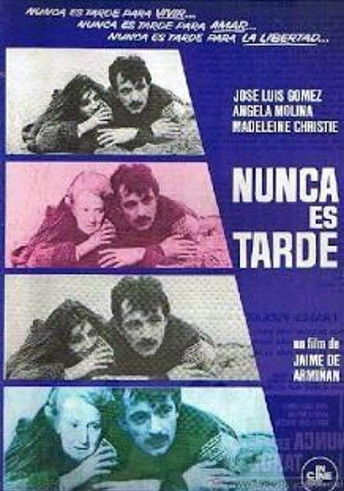
Nunca es tarde
1977
No user ratings available yet
Representation score: 7.7 out of 10

Representation Score
Fair
1980
PGDirector
Jaime de Armiñán
Runtime
97 minutes
Average Rating
No ratings yetNew Showbiz Analysis
Jaime de Armiñán’s film is a sophisticated deconstruction of provincial social structures. It prioritizes psychological autonomy over communal morality, using an unconventional relationship to challenge the rigid religious and social frameworks of 1980s Spain. The film excels in its critique of institutional authority. By portraying the village priest and patriarchal family structures as repressive forces, it adopts a stance of moral relativism that favors individual truth over systemic dogma. While the film lacks racial diversity due to its specific setting, it compensates through a nuanced exploration of gender ability to act and the subversion of traditional social hierarchies.
Category Breakdown
The film explores non-straight relationships and challenges traditional sexual hierarchies. It uses subtle hints to critique conventional domestic arrangements and societal expectations.
Female characters play a significant role in driving the story and have rich inner lives. The narrative contrasts weak-willed male authority figures with the autonomy of women, challenging patriarchal leadership.
The cast is homogeneous, reflecting a specific Spanish provincial setting. There is no evidence of intentional racial blending or casting actors of diverse backgrounds.
The film critiques Western institutional pillars like the Church and family. It portrays village morality as a source of repression rather than a moral compass.
There are no prominent depictions of physical or neurodivergent disabilities driving the narrative or serving as central character arcs.
Present on Screen
Limited or Absent
Official Synopsis
In a town near Salamanca, an eccentric widower, aged 60, is captivated by an imp, a precocious 13 year old. Alejandro is wealthy and alone, passing time with music, chess, and his shotgun. Gregoria (Goyita) the daughter of a weak-willed policeman and his bullying wife, is a budding naturalist who conspires to meet Alejandro. Even though he knows the village is talking, Alejandro spends time with Goyita, on walks, horseback rides, and dinners. He's enchanted and tells his friend the village priest that he's living for the first time. Goyita makes new demands on Alejandro, and he must decide how to be true to his ethics and to this Platonic yet highly-charged relationship.
1977

1962
1989
1974
1981
1987

1980

1980
No reviews yet. Be the first to share your thoughts on this movie!
Use the rating form above to leave a star rating and optional review.