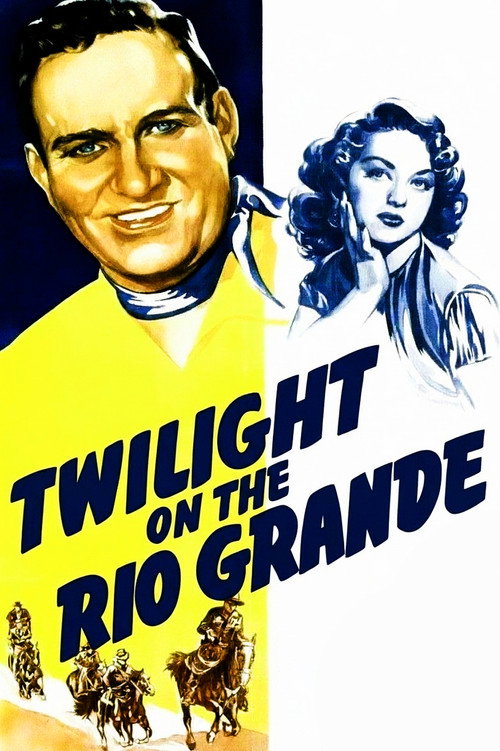
Twilight on the Rio Grande
1947
No user ratings available yet
Representation score: 1.0 out of 10
Representation Score
Limited
1941
PassedDirector
William Morgan
Runtime
64 minutes
Average Rating
No ratings yetNew Showbiz Analysis
The film opens with Gene Autry on horseback, a sun-drenched image that establishes the rural frontier as a space of moral clarity and physical competence. This visual language sells a vision where the "good" cowboy is the unimpeachable center of a white, orderly world. The narrative follows Autry as he investigates a poisonous weed threatening the rangeland, positioning him against the stubbornness of local ranchers and the skepticism of the community. The camera lingers on Autry’s polished appearance and confident demeanor, treating his whiteness and physicality as synonymous with virtue. The film’s argument is that merit and individual action, guided by scientific expertise, can resolve communal crises. Autry’s success in persuading the ranchers to accept aerial spraying reinforces the idea that the cowboy’s authority is both moral and practical. The romantic subplot with Sue Larrabee further cements this by rewarding Autry with domestic stability, framing the woman as the prize for his heroism. The ending, with its warm resolution and musical number, affirms the traditional hierarchy where the male lead’s competence and the female lead’s compliance create a harmonious society. However, the film’s internal logic is unchallenged by any critique of its own assumptions. The white, male-dominated world is presented as the natural order, with no space for alternative perspectives or identities. The absence of racial, gender, or disability diversity is not a flaw but a feature, reinforcing the idea that the ideal society is homogeneous and traditional. The film’s moral arithmetic is simple: good deeds are rewarded, and the cowboy’s virtue is the key to solving any problem. This unironic portrayal of rural life and male competence makes the film a clear example of traditional Western values, where the status quo is not just accepted but celebrated.
Category Breakdown
Absent. The narrative relies exclusively on heterosexual romance between Gene Autry and Sue Larrabee, with no depiction of same-sex intimacy or non-heteronormative identities.
Traditional. Gene Autry serves as the competent moral center who solves the crisis, while Sue Larrabee functions as the romantic prize rewarding his virtue. Women are passive recipients of male action rather than agents of change.
All-white. The cast consists entirely of white actors portraying a homogeneous rural community, reflecting the era’s unmarked default with no visible racial diversity or critique of settler dynamics.
Traditional. The film validates rural individualism and government-backed agricultural science as compatible goods, treating the cowboy’s merit and the land’s stability as the natural moral order.
Absent. No characters are depicted with physical or cognitive disabilities; the narrative focuses on able-bodied physical competence and rural labor without addressing impairment.
Present on Screen
Limited or Absent
Official Synopsis
To fight a poisonous weed, ranchers are burning their land. Gene is the Inspector brought in and he recommends spraying. The spraying goes well until the Larabee ranch is reached. When Larrabee refuses to allow the equipment on his land, Gene has it sprayed by airplane. Cattle must stay off recently sprayed land and when a Larrabee man shoots down the plane, the crash sends the cattle stampeding toward the newly sprayed land.
1947
1940

1941
1930
1945
1949
1942
1937
No reviews yet. Be the first to share your thoughts on this movie!
Use the rating form above to leave a star rating and optional review.