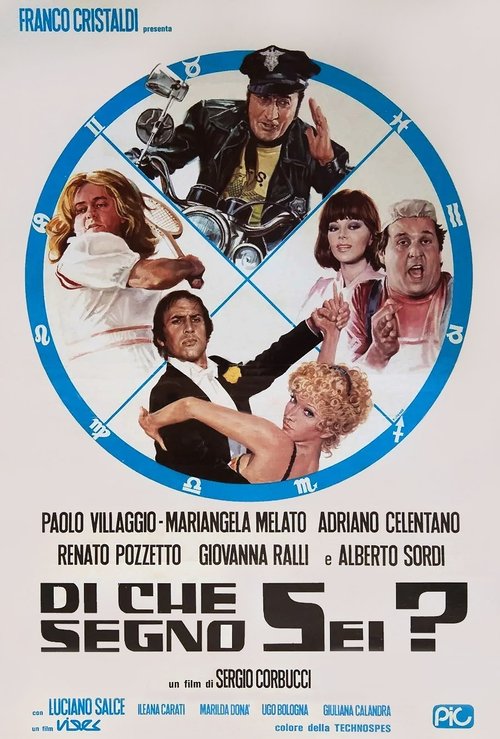
What's Your Sign?
1975
No user ratings available yet
Representation score: 4.2 out of 10
Representation Score
Limited
1983
Director
Sergio Corbucci
Runtime
119 minutes
Average Rating
No ratings yetNew Showbiz Analysis
Sergio Corbucci’s episodic comedy adheres to the conventional narrative structures of early 1980s Italian cinema. The film relies heavily on established romantic clichés and straight-centered dynamics, offering little disruption to social hierarchies. The storytelling focuses on individual psychological fixations and traditional gendered roles, lacking the complexity needed to challenge broader cultural or social norms, remaining within standard mid-century European cinematic conventions.
Category Breakdown
The film focuses solely on heterosexual relationships. Both segments center on traditional romantic interactions between men and women.
Female characters often act as muses or catalysts for male characters. While one woman drives her own psychological resolution, power dynamics still revolve around traditional gender roles.
The cast appears homogeneous, reflecting a conventional Western European social landscape. There is no indication of racial diversity or ethnic variety.
Narratives lean toward individual romantic fulfillment. The film avoids engaging with systemic critiques of religion, capitalism, or the nuclear family.
Psychological barriers are used as plot devices for romantic resolution. There is no nuanced exploration of mental health or neurodivergence beyond simple narrative utility.
Present on Screen
Limited or Absent
Official Synopsis
Two episodes. The 1st is 'Amore impossibile' (Impossible love). Giulio is a comic book draftsman. He is passing through a creativity depressed period. One day his editor makes him meet a blond nice girl. Immediately Giulio fall in love and starts to draw his impossible love story into a new comic book. The 2nd is 'Quello dal basco rosso' (the one with the red beret). Sandro, a mature man, meets one of his former girlfriend and her daughter Daniela. Daniela couldn't have sex with her boyfriend because of a childhood remembrance. In fact she always remember her mother having sex with a man wearing a red beret. She discovers that man is Sandro, makes love with him and soon recovers from her obsession.
1975
1980
1976
1963
1971

1976
1988
1962
No reviews yet. Be the first to share your thoughts on this movie!
Use the rating form above to leave a star rating and optional review.