Serene Velocity
1970
No user ratings available yet
Representation score: 0.6 out of 10
Representation Score
Minimal
1976
Director
Ernie Gehr
Runtime
13 minutes
Average Rating
No ratings yetNew Showbiz Analysis
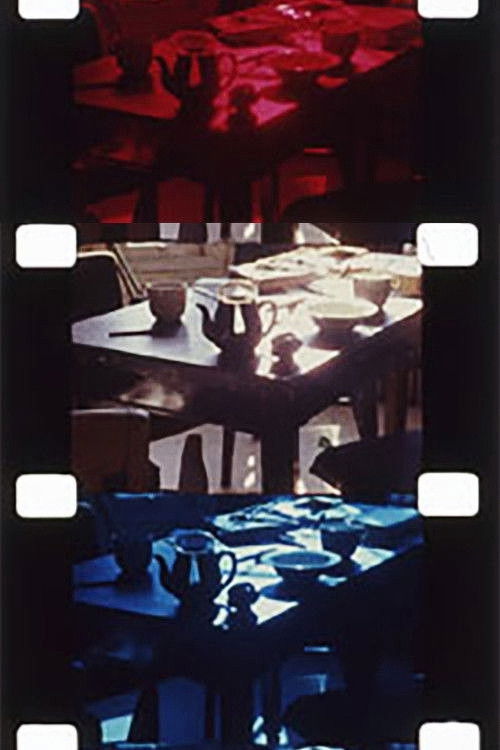
Ernie Gehr’s *Table* is a formalist experiment that exists outside the realm of social representation. By focusing on the mechanical properties of light and time through a study of kitchen utensils, the film lacks the human ability to act necessary for assessing demographic characteristics. While the film does not meet standard metrics for diverse representation, it disrupts passive consumption of media by deconstructing the cinematic apparatus itself. However, this does not translate into visible diversity. Ultimately, the work is a cubist-style study of objects rather than a narrative about people. Its value lies in its structural disruption of the medium rather than its portrayal of human characteristics.
Category Breakdown
Since the film focuses on inanimate objects, there are no human characters to depict LGBTQ identities or relationships.
The film centers on a kitchen table and its contents, lacking any human subjects and thus not engaging with traditional gender roles or hierarchies.
The subject matter is confined to household utensils and crockery, with no human cast to assess for racial or ethnic diversity.
The work employs radical formalism to disrupt conventional Western cinematic expectations, rejecting traditional narratives in favor of fragmented imagery and mechanical abstraction.
With no human characters in this structuralist experiment, there is no representation of physical or neurodivergent identities.
Present on Screen
Limited or Absent
Official Synopsis
"Table, shot in 1976 is the celluloid equivalent of a cubist Still Life. The subject is an ordinary kitchen table, a homely clutter of crockery and utensils. For 15 minutes, Gehr alternates two slightly different fixed points of view, accentuating individual shots through the use of blue and red filters (and sometimes no filter at all). This simple if painstaking procedure transforms the image into a stuttering hypnotic shuffle. Difficult to take in on a single viewing, Table improved with familiarity. As one learns how to look at it, one’s eyes wander around the frame to savor specific details. Some objects appear simultaneously in 2 positions, others flex their shimmering forms or collide with their neighbors, while a few barely seem to 'move' at all." - J. Hoberman
1970
1968
1964
1964

1970
1981
1974
1971
No reviews yet. Be the first to share your thoughts on this movie!
Use the rating form above to leave a star rating and optional review.