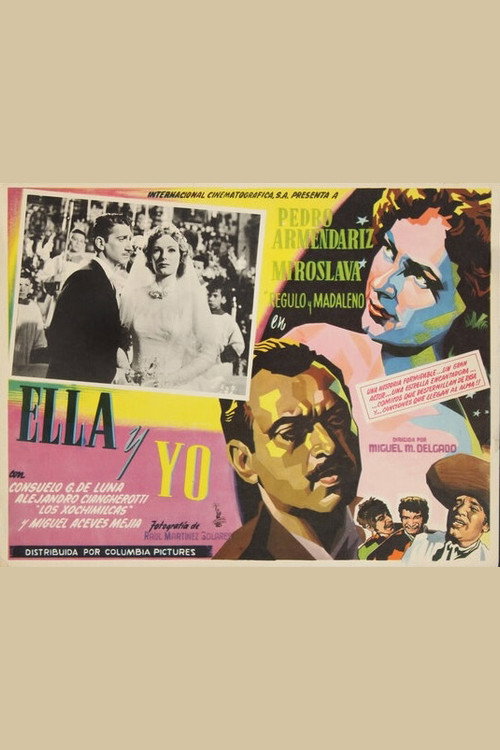
Ella y yo
1951
No user ratings available yet
Diversity score: 3.8 out of 10

1967
Not RatedDirector
Federico Curiel
Runtime
116 minutes
Average Rating
No ratings yetSynopsis
A woman jumping from the poverty of the countryside to the splendor of wealth in the city without losing its simplicity
Overall Score
Limited
Category Breakdown
LGBTQ+ Representation
The film adheres to the standard romantic and dramatic conventions of 1960s Mexican cinema. There is no evidence of non-cisnormative identities or narratives that critique heteronormativity.
Gender Representation
Silvia Pinal leads a classic rags-to-riches story. While the protagonist shows agency in her social climb, the narrative likely relies on traditional feminine archetypes of grace.
Racial & Ethnic Diversity
The production features a predominantly Hispanic cast. The story focuses more on the divide between rural and urban socioeconomic status than on intersectional racial dynamics.
Religious & Cultural Diversity
The plot emphasizes the preservation of simplicity amidst urban prosperity. It appears to engage with aspirational values rather than deconstructing traditional social institutions.
Disability Representation
There are no visible or invisible disabilities documented within the primary character arcs.
Strengths
Areas for Improvement
AI Analysis
María Isabel is a mid-century melodrama that centers on a female protagonist's journey from rural poverty to urban wealth. While the film grants agency to its lead, it operates within the conventional social and moral frameworks of 1967 Mexican cinema. The narrative prioritizes classical storytelling and social mobility over the disruption of established hierarchies. It functions as an aspirational tale rather than a subversive critique of class or gender. Ultimately, the film reflects the homogeneous social strata and traditional values typical of the Golden Age era, focusing on character preservation through socioeconomic change.
1951

1951

2012

1966

1975
1971

1942

1989

2001

1952
1968
No reviews yet. Be the first to share your thoughts on this movie!
Use the rating form above to leave a star rating and optional review.