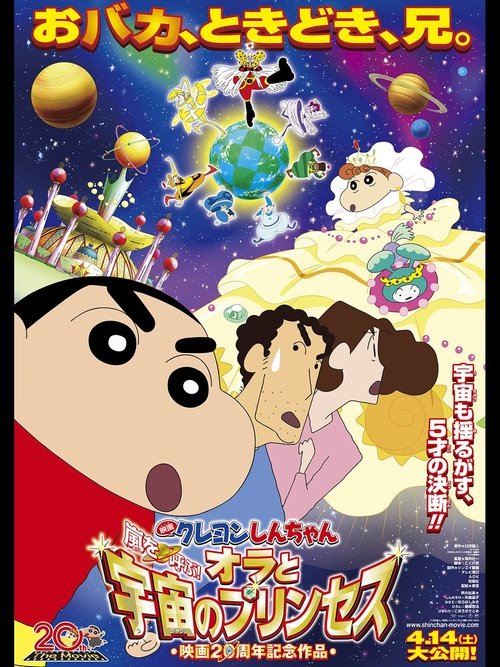
Crayon Shin-chan: Invoke a Storm! Me and the Space Princess
2012
No user ratings available yet
Representation score: 6.3 out of 10

Representation Score
Fair
2006
Director
Yuji Muto
Runtime
91 minutes
Average Rating
No ratings yetNew Showbiz Analysis
The film is a genre-specific musical comedy that relies on the irreverent, anti-social nature of its protagonist to provide social subversion. While Shinnosuke's antics challenge traditional authority and masculine leadership, the film stays within safe, conventional boundaries regarding identity and social structures. Diversity is primarily aesthetic, using a stylized Spanish-inspired setting to provide a sense of escapism. This provides a departure from the domestic norm but lacks the depth needed to challenge systemic norms. Ultimately, the work functions as a traditional family adventure. It prioritizes joy, movement, and communal unity over a progressive critique of social hierarchies.
Category Breakdown
The film does not center on LGBTQ+ identities and does not challenge the assumption that everyone is straight or cisgender. It does not actively disrupt traditional gender roles or social structures.
Shinnosuke's eccentric behavior disrupts traditional masculine expectations. However, broader gender hierarchies and domestic dynamics remain largely unchanged within the established Nohara family archetypes.
The setting uses Spanish-inspired aesthetics for cultural escapism rather than deep exploration. The cast remains largely homogeneous, centered on standard Kasukabe archetypes despite the foreign backdrop.
The narrative celebrates communal unity through dance and the protagonist's disregard for social etiquette. It focuses on musical adventure rather than a direct critique of Western institutions.
There is no significant presence of characters with visible or invisible disabilities. The narrative does not use disability as a central theme or tool for character development.
Present on Screen
Limited or Absent
Official Synopsis
Something sinister's afoot in Kasukabe. Shin-chan doesn't know what it is, but he's pretty sure it involves samba-dancing doppelgängers.
2012
2014

2014
2011
1994
1994
1985
1993
No reviews yet. Be the first to share your thoughts on this movie!
Use the rating form above to leave a star rating and optional review.