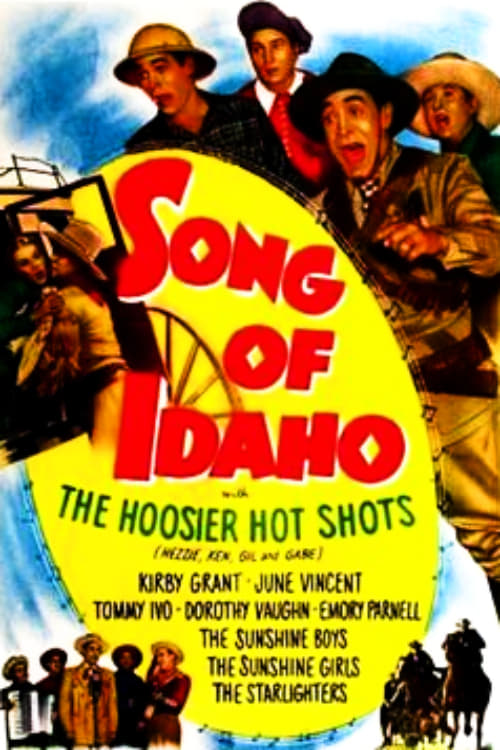
Song of Idaho
1948
No user ratings available yet
Representation score: 0.7 out of 10
Representation Score
Limited
1948
ApprovedDirector
Ray Nazarro
Runtime
62 minutes
Average Rating
No ratings yetNew Showbiz Analysis
The film opens on the rhythmic clatter of hooves, establishing the mechanical precision of the track before introducing the human drama. This 1948 Columbia B-movie sells a vision of rural stability where the horse is a metaphor for emotional control and the romantic bond is the ultimate reward. The sold meaning is clear: loyalty and male competence triumph over scheming and vulnerability. Margie, the innocent blonde, is protected by Bill, the rugged hero, while the “other women” serve as temporary threats to be neutralized. The film’s argument is that the traditional order—male authority, female support, rural merit—is the natural and desirable state. The ending reinforces this by restoring the romantic status quo, with the horse’s success serving as the backdrop for their personal union. The camera loves Margie for her innocence and Bill for his competence, framing the return to the couple as the ideal outcome. There is no satire or subversion; the film takes its world seriously, treating the stakes as genuine and the resolution as earned. The washboard march is a whimsical detail, but it does not challenge the underlying hierarchy. Instead, it adds a layer of charm to a narrative that rewards conformity and punishes deviation. The last image, likely a quiet moment of reconciliation, settles the film’s values: the good girl is saved by her man’s competence, and the world remains orderly. The film’s internal logic is consistent with its era, presenting a homogeneous, white, heterosexual world as the unmarked norm. The absence of diversity is not a flaw in the film’s logic but a reflection of its cultural context. The camera does not question the status quo; it celebrates it. The result is a straightforward, if unremarkable, example of mid-century B-movie storytelling, where the primary goal is to reassure the audience that the traditional order is safe and sound. The film’s strength lies in its clarity, not its complexity. It tells a simple story with simple values, and it does so effectively within its limited scope.
Category Breakdown
The narrative is strictly heterosexual, centering a romantic bond between Margie and Bill. No same-sex intimacy, queer coding, or non-heteronormative dynamics appear on screen.
Traditional hierarchy dominates. Margie is the loyal, vulnerable prize; Bill is the competent protector who resolves all conflicts. The scheming women serve as obstacles to the male lead’s success, reinforcing male authority as the narrative engine.
The cast is entirely white, reflecting the unmarked default of 1948 B-movie production. No non-white characters appear, and the world of horse racing is presented as exclusively white without commentary.
Western meritocracy and rural tradition are treated as good. The film validates the horse-racing community and the romantic status quo. The underlying value system rewards loyalty, stability, and male competence over disruption.
All characters are able-bodied. No disability is depicted, referenced, or used as a narrative element. The physical demands of horse racing are performed by healthy actors without impairment.
Present on Screen
Limited or Absent
Official Synopsis
Ken, Gil, Hezzie and Gabe are members of the Country & Western band 'The Hoosier Hotshots'. They get involved with the beautiful Margie MacGregor, the scheming villain Pamela Trent and horse races. The Hoosier Hotshots discover that a horse will trot like a champion only when he hears a march played on a washboard.
1948
1937
1944
1953
1943

1944

1942
1958
No reviews yet. Be the first to share your thoughts on this movie!
Use the rating form above to leave a star rating and optional review.