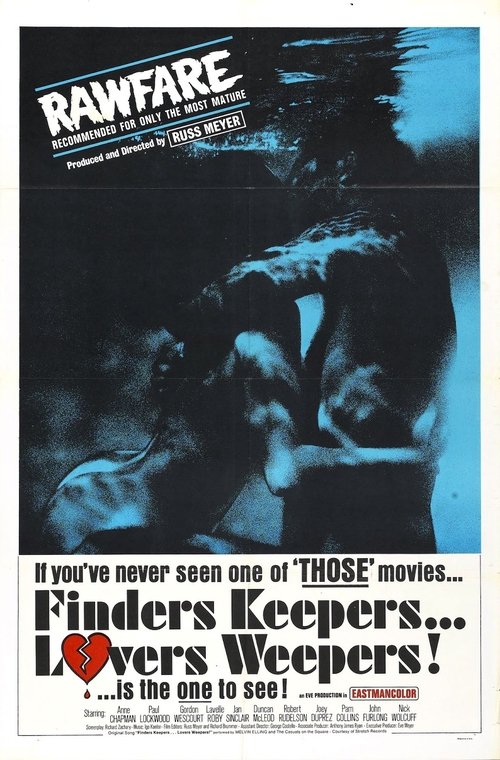
Finders Keepers, Lovers Weepers
1968
No user ratings available yet
Diversity score: 4.2 out of 10

1967
Director
Russ Meyer
Runtime
80 minutes
Average Rating
No ratings yetSynopsis
Tales of eleven losers are told and interwoven. Burt can't satisfy Angel, so she seeks the arms of another man, who is caught by Angel in the arms of another woman. Angel ends up with Justin, who ends up with a co-worker's wife. As Angel and Burt argue, a sorceress watches, and eventually seduces Burt while Angel gets to know Ray, who had previously chased a blonde girl down on the coast. You get the idea.
Overall Score
Fair
Category Breakdown
LGBTQ+ Representation
The film explores sexual non-conformity and rejects monogamous structures. However, it lacks explicit same-sex intimacy or queer-coded characters to move beyond a low score.
Gender Representation
Women drive the plot through their pursuit of autonomy and sexual agency. The narrative subverts patriarchal leadership by portraying male characters as reactive or inadequate.
Racial & Ethnic Diversity
The casting appears to reflect the homogeneous, predominantly white demographics typical of 1960s exploitation cinema. There is no evidence of significant racial or ethnic diversity.
Religious & Cultural Diversity
The story prioritizes subjective desire over traditional Christian morality. It frames sexual transgression as narrative momentum rather than a moral failing, challenging domestic sanctity.
Disability Representation
There is no discernible evidence regarding the representation of physical or neurodivergent disabilities within the film.
Strengths
Areas for Improvement
AI Analysis
Russ Meyer’s work disrupts mid-century cinematic norms by centering female physicality and agency. The film challenges the era's rigid moral hierarchies by prioritizing individual desire over the stability of the nuclear family. While the film subverts gendered power dynamics, it lacks intersectional breadth. The narrative remains largely homogeneous in its racial representation and lacks explicit LGBTQ+ identities. Ultimately, the film is a study in sexual autonomy that succeeds in deconstructing social contracts while failing to include a diverse range of racial or physical identities.
1968

1970

1969
1970
1969

1977

1972
1986

1967
1967

1969

1968
No reviews yet. Be the first to share your thoughts on this movie!
Use the rating form above to leave a star rating and optional review.