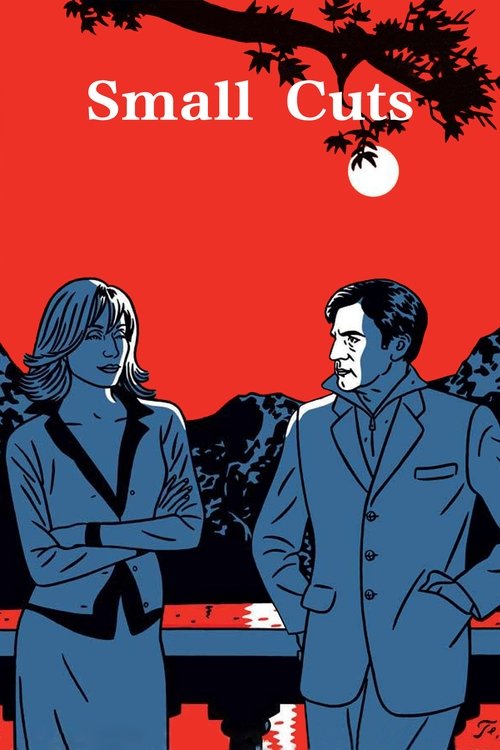
Small Cuts
2003
No user ratings available yet
Representation score: 6.7 out of 10
Representation Score
Good
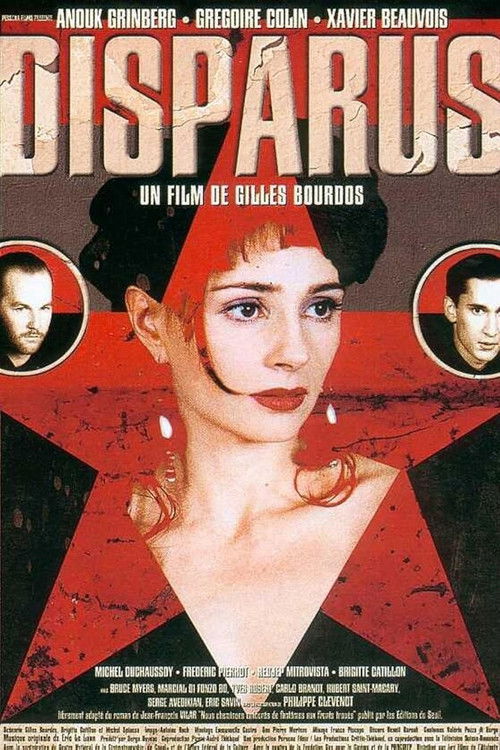
1998
Director
Gilles Bourdos
Runtime
100 minutes
Average Rating
No ratings yetNew Showbiz Analysis
Disparus is a nuanced historical drama that avoids a sanitized portrayal of the mid-20th century. It effectively explores the interplay of art and ideology through characters who operate outside the mainstream social consensus. The film skillfully uses historical context to shape character identity, particularly through the lens of Jewish radicalism and political upheaval. It challenges traditional power structures by highlighting revolutionary morality. However, the narrative remains predominantly centered on heterosexual relationships. While it provides rich ethnic and political representation, it lacks explicit LGBTQ+ identities or disability representation.
Category Breakdown
The film explores the romantic relationship between Alfred Katz and Mila within surrealist circles. However, it does not explicitly depict non-traditional gender identities or queer-coded pairings, staying focused on heterosexual relationships.
Mila's character stands out for her independence and defiance of traditional submissive roles. She navigates a male-dominated political landscape on her own terms, challenging conventional gender expectations.
Alfred Katz's identity as a Jewish radical is central to the plot's tension. The film highlights the systemic pressures faced by Jews in pre-WWII Paris, emphasizing the intersection of ethnicity and politics.
The narrative critiques Western power structures through Trotskyite and Stalinist ideologies. It focuses on avant-garde surrealism and radical political thought rather than traditional religious or nationalist ideas.
There are no visible representations of physical, sensory, or neurodivergent disabilities in the narrative.
Present on Screen
Limited or Absent
Official Synopsis
Sex, avant-garde art, and Communist ideology are at the heart of this compelling historical drama. The film opens just as the Soviet Empire crumbles in 1989. As Louise mourns the death of her lover, she discovers the journal of Alfred Katz, an earnest Jewish radical and erstwhile poet who disappeared in 1938. With the aid of a history professor, Louise unravels what happened to Katz. In the feverish climate of pre-WWII Paris, Katz reveals himself as both a fervent Trotskyite and an unabashed romantic. At a party thrown by the noted surrealist Andre Breton, he meets Mila, a beautiful part-time model, part-time whore. As soon as he falls for her, he learns of her other lover Felix, a fervent Stalinist. Bored with politics, Mila eventually marries Katz. Soon betrayal and politics catch up with the poet.
2003

1994
1985
2008
1967
2002
1985
1995
No reviews yet. Be the first to share your thoughts on this movie!
Use the rating form above to leave a star rating and optional review.