Analogies: Studies in the Movement of Time
1977
No user ratings available yet
Representation score: 7.2 out of 10
Representation Score
Minimal
1989
Director
Martin Arnold
Runtime
16 minutes
Average Rating
No ratings yetNew Showbiz Analysis
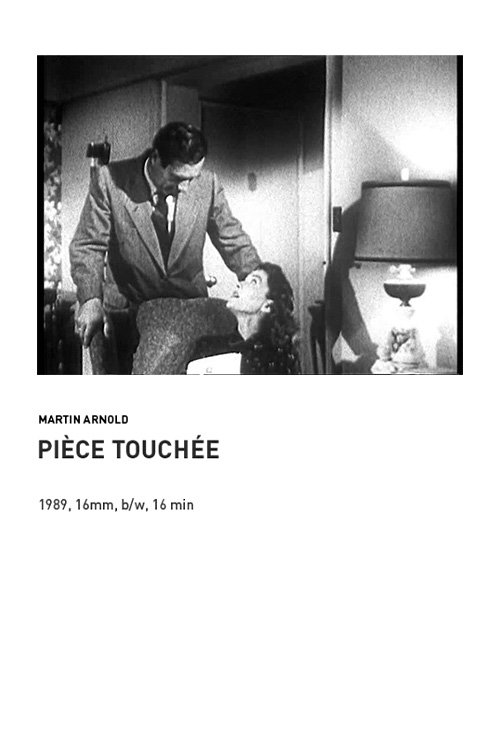
Martin Arnold’s *Pièce touchée* is a formalist experiment rather than a social drama. It expands an eighteen-second domestic clip into a sixteen-minute study of subtle gestures, using temporal manipulation to deconstruct cinematic continuity. While the film lacks demographic diversity or varied representation, its strength lies in its structural disruption. By breaking down the stability of space and time, it challenges the 'ordered' reality of traditional cinematic formulas. Ultimately, the work serves as a postmodern critique of the domestic sphere. It replaces traditional character development with a rhythmic, mechanical repetition that makes the familiar seem strange.
Category Breakdown
The film does not depict any non-straight relationships or queer narratives. It focuses solely on a typical husband-and-wife dynamic from the mid-20th century.
The film showcases a man and a woman in a traditional mid-century household setting. Although it does not challenge traditional gender roles, the distorted editing creates an unsettling effect on the stability of these spaces.
The film uses source material from the 1950s, which reflects a predominantly white, Western-centric casting. There is no indication of diverse racial representation or non-white majority casting.
The film emphasizes formal properties over a moralistic storyline and avoids promoting specific religious traditions. It employs postmodern techniques to critique the perceived order of Western domestic life.
The film does not include any characters with physical, sensory, or neurodivergent disabilities. Its focus remains on the formal manipulation of existing footage.
Present on Screen
Limited or Absent
Official Synopsis
Arnold's source material is a piece of footage from the 1950s, eighteen seconds long and very typical for the period. A quiet take: A living room, a woman in an armchair. Her husband opens the door, kisses her, then moves out of the picture accompanied by a camera pan, his wife follows after him. In Arnold's film the sequence takes 16 minutes. Cadre by cadre, it becomes an exciting tango of movements. But Pièce Touchée is more than just a matter of forms; The reflections, distortions and delays it displays challenge cinema's stable system of space and time.
1977

1970
1981
1976
1970
1966
1987
1968
No reviews yet. Be the first to share your thoughts on this movie!
Use the rating form above to leave a star rating and optional review.