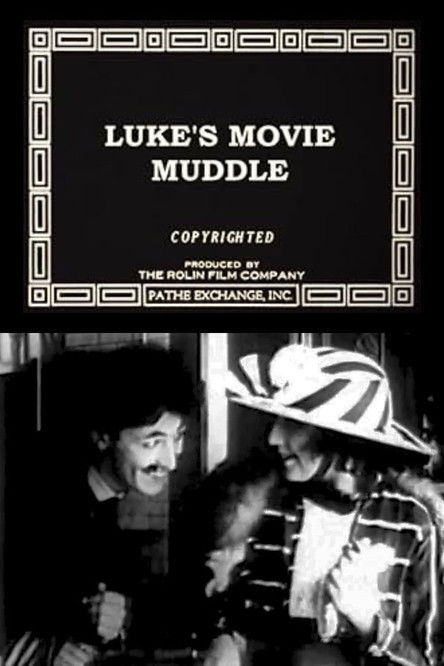
Luke's Movie Muddle
1916
No user ratings available yet
Representation score: 2.5 out of 10

Representation Score
Minimal
1917
NRDirector
Hal Roach
Runtime
11 minutes
Average Rating
No ratings yetNew Showbiz Analysis
Lonesome Luke, Messenger opens with Harold Lloyd in his signature round spectacles, a clean-cut messenger preparing for a delivery run. The image sells a specific 1917 ideal: the boy-next-door whose moral worth is proven through physical utility and unthreatening innocence. Lloyd’s Luke is the unmarked majority, a white, young male whose competence is the film’s engine. He is not a villain, nor is he a hero in the traditional sense; he is a vessel for kinetic morality. The camera lingers on his face, framing his eyes behind the glasses as the moral center, while Bebe Daniels, the "Girl," is positioned as the destination. She is beautiful, passive, and the reward for his labor. The film’s argument is simple: individual effort and innocence will triumph over systemic or personal aggression. There is no irony, no satire, and no subversion. The world is one where social order is maintained through physical agility and moral purity, not institutional power. Luke never pays for his mistakes; his harm is minimal and always recoverable. The antagonist, if present, is bulky and clumsy, a foil to Luke’s polish. The ending rewards persistence and innocence, punishing the antagonist’s aggression with physical slapstick rather than moral retribution. The film is a sincere celebration of the working-class youth as the true hero, not the wealthy or the powerful. It is a product of its time, reflecting the era’s default without commentary. The pictures like the competent male and the passive female prize. The joke is the antagonist’s clumsiness. The legend printed is that the working-class youth is the true hero. The film is a snapshot of a world where merit is earned through labor and physical endurance, and where social hierarchies are unchallenged and unmarked. It is a traditional, unproblematic, and entirely white world, where the only conflict is physical and the only resolution is kinetic.
Category Breakdown
No queer characters or same-sex intimacy appear. Heteronormative courtship is the sole relational dynamic implied by the 1917 silent short.
Luke is the competent male driver; Bebe Daniels is the passive female prize. Women serve as objects of desire and moral validation, not plot agents.
The cast is entirely white, reflecting the era’s unmarked default. No non-white characters appear, and whiteness operates as the invisible background.
Working-class merit and physical endurance are treated as inherent virtues. Institutional hierarchies remain unchallenged, and social order is maintained through individual innocence.
No characters have disabilities. Physical comedy relies on temporary, reversible injuries rather than impaired bodies or ongoing disability.
Present on Screen
Limited or Absent
Official Synopsis
While on the job, delivering a message, Luke finds himself in a girl's seminary.
1916
1926
1919

1923
1914
1928

1919
1921
No reviews yet. Be the first to share your thoughts on this movie!
Use the rating form above to leave a star rating and optional review.