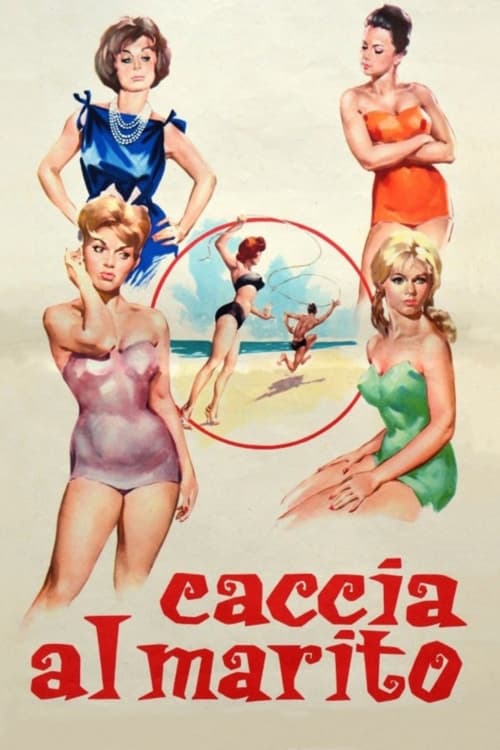
Caccia al marito
1960
No user ratings available yet
Representation score: 1.4 out of 10
Representation Score
Minimal
1960
Director
Marino Girolami
Runtime
87 minutes
Average Rating
No ratings yetNew Showbiz Analysis
The film opens on a chaotic, sun-drenched Italian beach, where the camera immediately treats the female form as the primary commodity. This 1960 comedy by Marino Girolami sells a vision of summer vitality, but its internal logic reinforces a rigid hierarchy of national and gendered roles. Walter Chiari’s Harold Pasquale Esposito is the unmarked majority: a wealthy, confident foreigner whose sexual agency is never questioned. He is the active agent, the pursuer, and the ultimate beneficiary of the film’s social arithmetic. The sold meaning is clear: Italian and Italian-American men are sexually superior, while women are prizes to be won. Valeria Fabrizi’s Erica represents the "good" woman, defined by her accessibility and eventual submission to Harold’s authority. Her morality is not tested by internal conflict but by her willingness to accept the male lead’s dominance. The camera loves her body and his charm, framing their union as the desired resolution to the beach’s earlier sexual chaos. The film’s argument pulls apart when it claims to satirize summer tourism’s pretensions but ultimately loves the status quo it depicts. The German character, played by Gérard Landry, is the primary joke, his rigidity mocked to highlight the Italian lead’s vitality. This ethnic stereotyping serves the film’s central thesis: that the "normal" is the sexually free, wealthy Western male. The older woman, Marta, is also a joke, her sexuality treated as inappropriate or desperate in contrast to Erica’s youthful purity. The last image is a conventional, warm embrace that signals the triumph of normative structure over chaos. Harold never pays a price for his cultural arrogance or sexual aggressiveness; he is simply rewarded with stability. Erica is not billed for the loss of her autonomy; her "harm" is the loss of virginity, which is compensated by marriage. The film ends where it began: with the camera celebrating the male gaze and the restoration of the nuclear family as the moral verdict.
Category Breakdown
No same-sex intimacy or non-heteronormative identities appear. The narrative relies entirely on heterosexual pairings and romantic conquest. The film offers no alternative frameworks for sexual identity.
Walter Chiari’s character acts as the active pursuer and competent savior. Valeria Fabrizi’s Erica functions as the passive prize. Female agency is limited to eventual acceptance of the male lead’s dominance.
Ethnic stereotyping defines the cast. The German character serves as a rigid, comical foil to the Italian-American lead’s vitality. Non-white characters are absent from the primary social dynamics.
The film restores social order through a romantic union that rewards the wealthy, confident foreigner. The beach setting frames pre-family chaos, resolved by the stability of the nuclear couple.
No characters display physical or cognitive impairments. The focus remains on youthful, able-bodied physicality and sexual availability. Disability is entirely absent from the narrative.
Present on Screen
Limited or Absent
Official Synopsis
Sun, Sea, Love and a beautiful Italian beach...
1960
1980
1961
1978
1962

1983
1983
1960
No reviews yet. Be the first to share your thoughts on this movie!
Use the rating form above to leave a star rating and optional review.