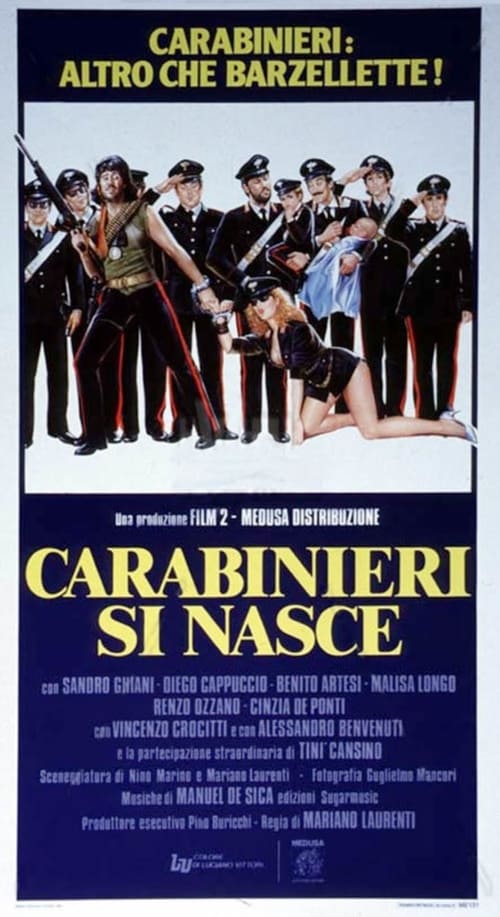
Carabinieri si nasce
1985
No user ratings available yet
Representation score: 1.6 out of 10

Representation Score
Limited
1973
Director
Mario Forges Davanzati
Runtime
100 minutes
Average Rating
No ratings yetNew Showbiz Analysis
The film's diversity profile highlights a contrast between progressive gender dynamics and demographic homogeneity. It successfully challenges traditional gender roles by centering a strong, intelligent female protagonist. However, its limitations stem from its regional and temporal context, lacking significant racial and LGBTQ+ diversity. The film remains narrow in its broader social representation despite its progressive gender dynamics.
Category Breakdown
The film does not feature any explicit LGBTQ+ characters or narratives. The central romantic relationship focuses solely on the marriage between Pasquale and Roberta, which is strictly oriented toward straight relationships.
The film disrupts traditional gender roles by making Roberta the main character who drives the story with her intellect and physical strength. Her martial arts skills and physical dominance challenge the stereotype of the passive female partner.
The cast is fairly uniform, reflecting the local cinematic traditions of 1970s Italy. While it avoids harmful stereotypes, it does not offer much diversity in terms of race or cultural backgrounds.
The film criticizes the effectiveness of institutions through the protagonist's struggles against both law enforcement and organized crime. It avoids traditional heroic clichés, instead offering a more cynical view of social mobility.
The film does not feature any characters with visible or invisible disabilities as central plot devices or subjects of ridicule.
Present on Screen
Limited or Absent
Official Synopsis
A bumbling police officer suffers a series of demotions, but is determined to prove his worth. At last, he is assigned to an important case—or so he believes, since his colleagues are actually using him as bait. Despite everything, his contribution proves decisive, but even more decisive is that of his wife, a formidable karate champion, amid mistaken identities, brawls, and other complications. To display the long-awaited recognition he has earned, however, the police sergeant has to award it to himself, with the help of a porter.
1985

1980
1983
1973
1971
1975

1967
1976
No reviews yet. Be the first to share your thoughts on this movie!
Use the rating form above to leave a star rating and optional review.