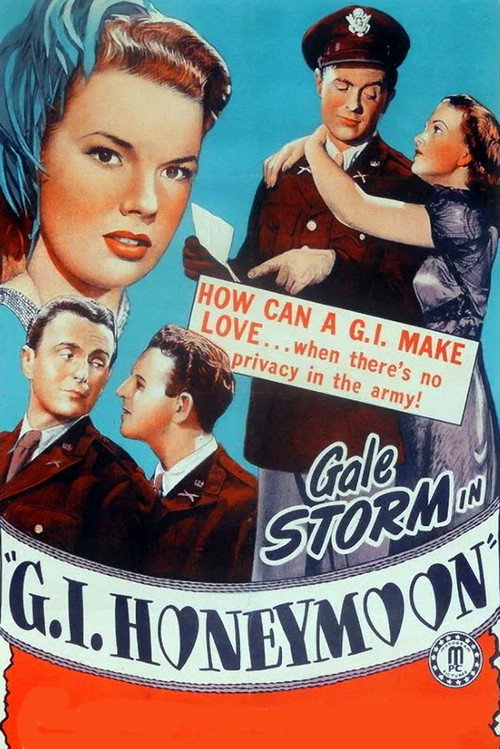
G.I. Honeymoon
1945
No user ratings available yet
Representation score: 1.6 out of 10
Representation Score
Minimal
1945
PassedDirector
Phil Rosen
Runtime
67 minutes
Average Rating
No ratings yetNew Showbiz Analysis
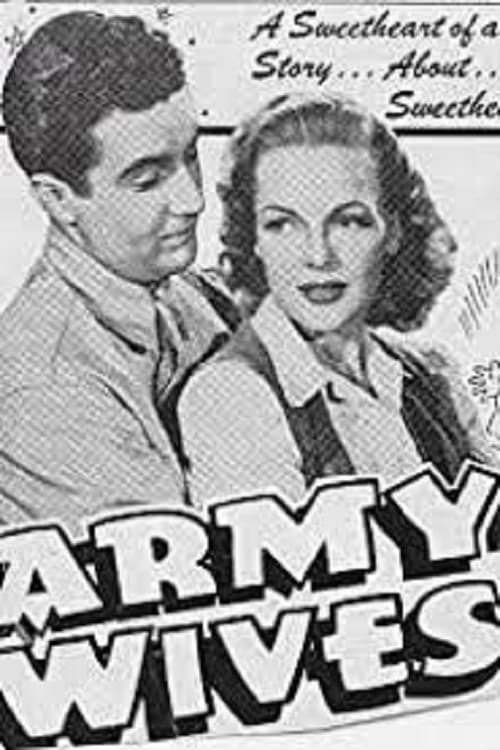
Army Wives is a period-typical comedy that adheres strictly to the social hierarchies and narrative conventions of the mid-1940s. The plot centers on a localized conflict regarding class and romantic timing rather than broader social issues. The film lacks multi-layered complexity or any intentional disruption of traditional norms. It functions as a standard studio production of its era, prioritizing romantic legitimacy and social cohesion over progressive representation. Ultimately, the work serves as a snapshot of 1940s cinematic codes, focusing on a debutante's struggle to marry a corporal despite familial opposition.
Category Breakdown
The film focuses on a conventional romantic pursuit between a debutante and a corporal. It lacks any evidence of non-assuming gender matches what was assigned at birth identities or critiques of the assumption that everyone is straight or cisgender.
The female protagonist takes control by pursuing a marriage against her family's wishes. However, the narrative remains rooted in traditional romantic clichés and social class conflicts.
The film likely reflects the homogeneous casting standards of 1945. There is no indication of a diverse ensemble that challenges the period's demographic norms.
The story utilizes class friction and familial authority within a traditional comedic structure. It reinforces the stability of social institutions like the military and nuclear family.
There is no evidence of characters with visible or invisible disabilities in the narrative.
Present on Screen
Limited or Absent
Official Synopsis
When Jerry Van Dyke, a young debutante, decides to marry Barney, an Army corporal, whom she met at a USO dance, her family objects and consequently, the couple are unable to obtain a marriage license because Jerry doesn't come of age for four days.
1945

1944

1945
1949
1956
1945

1953
1945
No reviews yet. Be the first to share your thoughts on this movie!
Use the rating form above to leave a star rating and optional review.