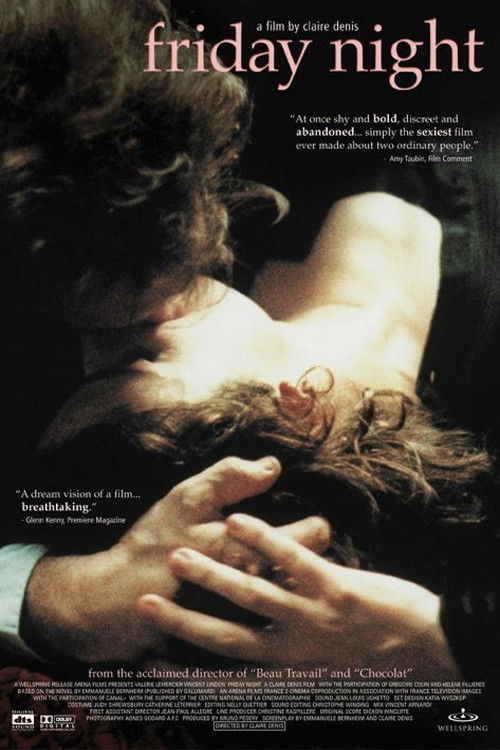
Friday Night
2002
No user ratings available yet
Representation score: 9.1 out of 10
Representation Score
Fair
1991
Director
Claire Denis
Runtime
42 minutes
Average Rating
No ratings yetNew Showbiz Analysis
Claire Denis delivers a character-driven study of displacement and emotional vulnerability. The film succeeds by challenging traditional romantic archetypes, specifically through its portrayal of a male subject who is unreliable and fearful rather than dominant. By centering the narrative on Sophie's internal experience of abandonment, the film prioritizes the female protagonist's psychological autonomy. This shift away from male-driven plots allows for a more nuanced exploration of isolation within a foreign landscape. However, the film remains somewhat narrow in its scope. The focus on a specific Eurocentric migratory experience and the lack of documented queer ability to act or diverse supporting casts limit its broader multi-layered impact.
Category Breakdown
The film focuses on a single romantic pursuit and the isolation of the protagonist. There is no explicit evidence of non-straight relationships or queer-coded subtext within the narrative.
Sophie is a central female protagonist navigating a world defined by male absence. The male figure is portrayed as emotionally fragile and fearful, disrupting traditional depictions of masculine stability.
The story centers on a French expatriate experience in New York City. While the urban setting offers potential for diverse representation, the narrative focus remains on a specific Eurocentric migratory journey.
The film explores themes of displacement and the breakdown of romantic expectations. It prioritizes a subjective, melancholic exploration of individual truth over established social or institutional norms.
There is no evidence of characters with visible or invisible disabilities in the film.
Present on Screen
Limited or Absent
Official Synopsis
Sophie comes to New York from France with the intention of joining a man she met a few months before. She finds herself alone in the apartment of the guy, who left town because he was scared stiff at the idea of seeing her. Originally commissioned as one third of an omnibus feature showcasing the Figaro, a Japan-only retro throwback car.
2002
1984

1997

1973
1984
1986
1992

1982
No reviews yet. Be the first to share your thoughts on this movie!
Use the rating form above to leave a star rating and optional review.