Strange Culture
2007
No user ratings available yet
Diversity score: 5.5 out of 10
2010
Director
Alain-Michel Blanc, Gilles Amado, Thomas Bornot
Runtime
90 minutes
Average Rating
No ratings yetSynopsis
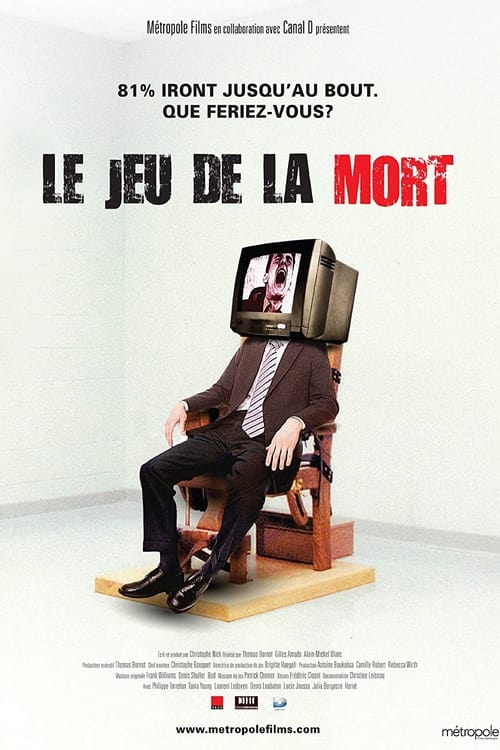
The Game of Death is a documentary co-produced by France Télévisions and Radio Television Switzerland1 in 2009 and staging a fake game show (The Xtreme Zone) during which a candidate must send electric shocks increasingly strong candidate to another until voltages that can cause death. The staging reproduces the Milgram experiment carried out initially in the United States in 1960 to study the influence of authority on obedience: electric shocks are fictitious, an actor pretending to suffer, and objective is to test the ability to disobey the candidate who inflicts this treatment and who is not aware of the experiment. The notable difference with the original experience is that scientific authority is replaced by a television presenter, Tania Young.
Overall Score
Fair
Category Breakdown
LGBTQ+ Representation
The documentary focuses on psychological obedience rather than identity-based narratives. There is no explicit evidence of LGBTQ+ characters or stories centered on non-cisnormative identities.
Gender Representation
The film subverts traditional tropes by placing Tania Young in a position of absolute authority. This challenges the perception of women as passive figures by making her the catalyst for obedience.
Racial & Ethnic Diversity
The film prioritizes the psychological mechanics of the experiment over a curated demographic spread. There is no specific evidence regarding a non-white majority or diverse racial casting.
Religious & Cultural Diversity
The narrative offers a sharp critique of Western institutions and the power of media spectacles. It explores how systemic authority and social conditioning influence human morality.
Disability Representation
The production uses an actor to simulate physical distress through fictitious electric shocks. There is no evidence of meaningful representation of neurodivergence or physical disability as a central theme.
Strengths
Areas for Improvement
AI Analysis
The film functions primarily as a social experiment rather than a character-driven narrative. It succeeds in deconstructing institutional authority by replacing scientific figures with a media personality, which provides a unique lens on power dynamics. However, the documentary lacks depth in identity-based representation. It remains neutral regarding LGBTQ+, racial, and disability themes, focusing instead on the universal mechanics of human obedience under systemic pressure. Ultimately, the work's strength lies in its cultural critique of Western social structures rather than its commitment to diverse demographic inclusion.
2007

2015

2021

2023
2018
2011
2005
2023

2013

2008
2022
2016
No reviews yet. Be the first to share your thoughts on this movie!
Use the rating form above to leave a star rating and optional review.