Mandabi
1968
No user ratings available yet
Diversity score: 6.5 out of 10
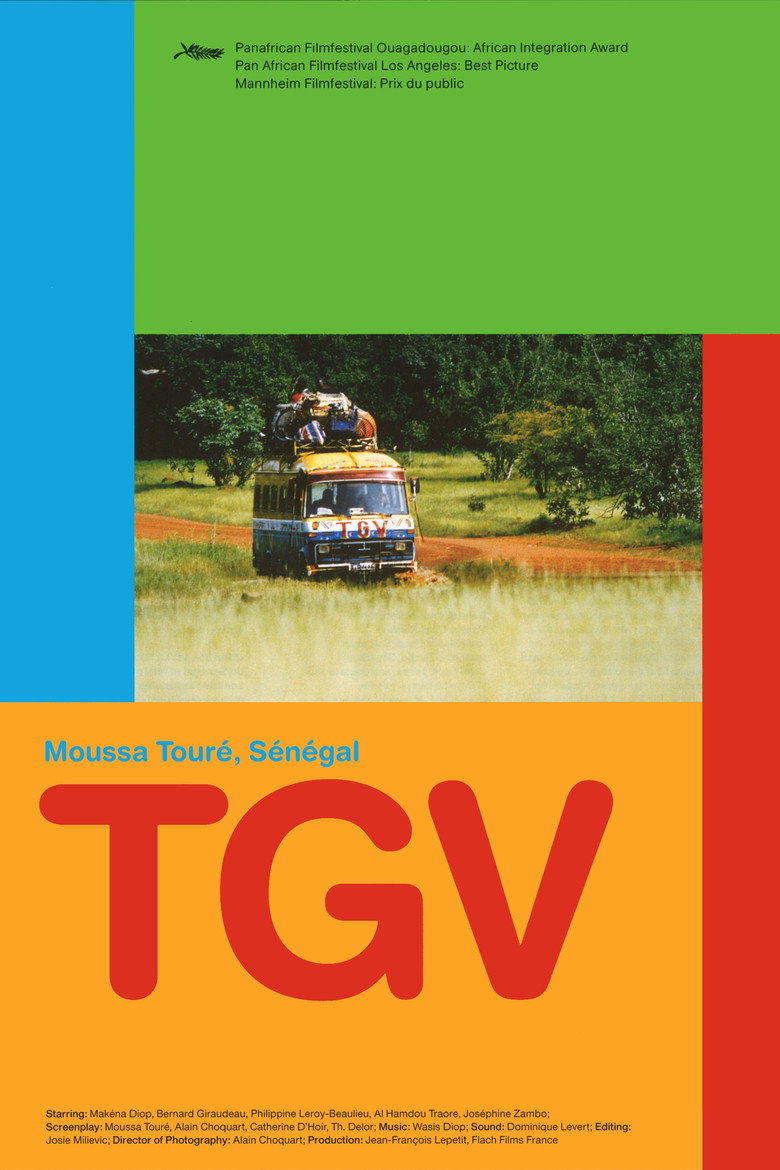
1998
Director
Moussa Touré
Runtime
88 minutes
Average Rating
No ratings yetSynopsis
The TGV? No, it is not the famous French high-speed train, but instead the rickety and colourful bus operated, driven, repaired and, if need be, pushed by the intrepid "Rambo". This time, the trip between Dakar, the capital of Senegal, and Conakry, the capital of Guinea, is outright dangerous: the road crosses the territory of the Bijagos, who have launched an unexpected and violent insurrection. Rambo finds several odd passengers (with a handful of sheep) who are ready, for various legitimate or untold reasons, to take every risk to reach Conakry. And the TGV sets off on an eventful journey...
Overall Score
Good
Category Breakdown
LGBTQ+ Representation
The film focuses on a collective of travelers navigating a physical and political landscape. There is no discernible presence of queer-coded subtext or non-heteronormative identities within the character arcs.
Gender Representation
The narrative is heavily centered on the male experience, specifically through Rambo and his male passengers. Female characters appear secondary, as agency in dangerous public spaces remains primarily a male domain.
Racial & Ethnic Diversity
The film excels with an all-Black cast that centers the cultural and linguistic landscape of Senegal and Guinea. This approach disrupts Western-centric cinematic norms by providing characters of color full agency.
Religious & Cultural Diversity
The story offers a profound critique of capitalist structures and systemic economic failures. It uses the rickety bus as a metaphor for the precariousness of life within a developing nation's infrastructure.
Disability Representation
There are no prominent depictions of visible or invisible disabilities that serve as central narrative drivers in this journey.
Strengths
Areas for Improvement
AI Analysis
Moussa Touré’s TGV is a vibrant piece of West African cinema that uses the road movie genre to explore the friction between traditional life and modern economic survival. It succeeds most significantly in its authentic regional representation, centering a sovereign, Black-led narrative that avoids the Western gaze. However, the film operates within a traditional social framework. The perspective is largely male-dominated, with women occupying secondary roles, and there is a total absence of LGBTQ+ representation or queer-coded subtext. Ultimately, the film's strength lies in its sophisticated post-colonial critique. It uses the struggle of the journey to highlight systemic poverty and the limitations of modern economic models, providing a nuanced look at marginalized lived realities.
1968
2019
2016
2017
2007
2019
2005
1996
2005
1999
1993
2021
No reviews yet. Be the first to share your thoughts on this movie!
Use the rating form above to leave a star rating and optional review.