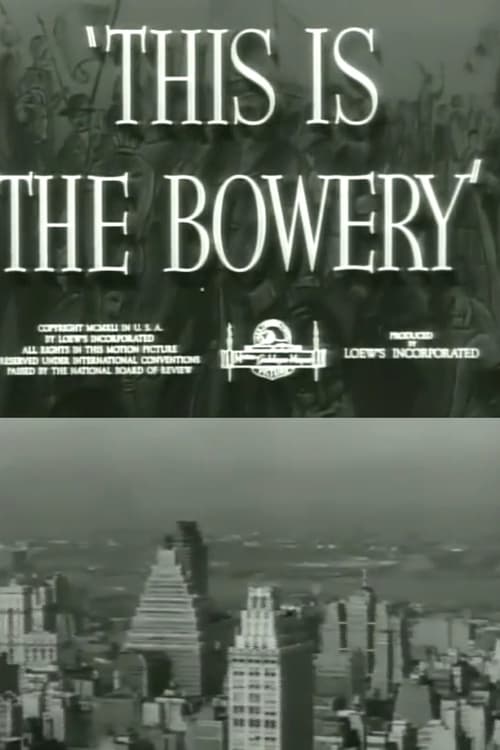
This Is the Bowery
1941
No user ratings available yet
Diversity score: 1.4 out of 10
No Poster Available
1943
ApprovedRuntime
11 minutes
Average Rating
No ratings yetSynopsis
This John Nesbitt's Passing Parade short takes a look at the evolution of the American city, from the initially small farming village, to the eventually hectic, congested metropolis, to the future planned suburban community.
Overall Score
Minimal
Category Breakdown
LGBTQ+ Representation
The film offers no framework for exploring gender identity or sexual orientation. There are no discernible non-cisnormative identities or narratives addressing heteronormativity.
Gender Representation
The documentary prioritizes macro-scale societal development like architecture and transport. It likely reinforces traditional social hierarchies by centering on masculine-coded spheres of industry and civic leadership.
Racial & Ethnic Diversity
The narrative focuses on the evolution of Western-style urban centers. It likely reflects the homogeneous demographic norms of the 1940s, potentially overlooking the diverse ethnic compositions of actual cities.
Religious & Cultural Diversity
The film celebrates Western values of progress, industrialization, and organized civic structure. It endorses institutional order and the optimization of the American landscape through a developmentalist lens.
Disability Representation
The focus remains strictly on the mechanical and structural evolution of the environment. There is no evidence of subjects navigating physical or neurodivergent realities.
Strengths
Areas for Improvement
AI Analysis
This documentary functions as a traditionalist historical survey of American urbanism. It traces the trajectory from agrarian settlements to planned suburban communities, focusing on infrastructure rather than character-driven narratives. The film's architecture reinforces a specific vision of civic progress. This vision aligns with the established social hierarchies and conventional Western developmental ideals prevalent in 1943. Because the subject matter is instructional and chronological, it lacks the depth required to explore diverse human identities, instead prioritizing the evolution of the built environment.
1941
1955

1948
1938

2009
1941
1954
1943
1936
1950
1949
1940
No reviews yet. Be the first to share your thoughts on this movie!
Use the rating form above to leave a star rating and optional review.