
The Girl Most Likely
1958
No user ratings available yet
Representation score: 0.4 out of 10
Representation Score
Limited
1964
ApprovedDirector
Don Weis
Runtime
85 minutes
Average Rating
No ratings yetNew Showbiz Analysis
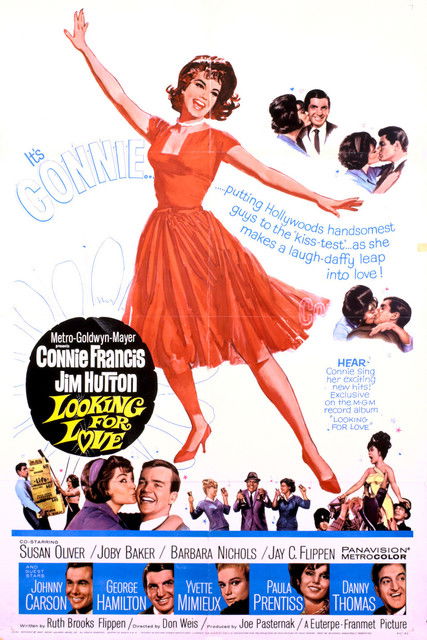
The film opens with Connie Francis as a pop idol, her face framed in close-up as she sings "Looking for Love," a number that explicitly rejects fame and diamonds in favor of "towels marked his and hers." This lyric sets the sold meaning: the camera loves the star, but the story argues that her true value lies in domestic submission. Libby Caruso is the visual prize, her blonde hair and bright dresses treated as holy objects, yet her competence is strictly decorative. She invents the "Lady Valet" clothes rack, a practical solution to a mundane problem, but the narrative immediately hands the reward to Paul Davis, who promotes the product and secures her a spot on Johnny Carson’s show. The joke is Libby’s indecision; the reward is Paul’s stability. The film’s internal logic pulls apart when Libby’s career success, sparked by her own invention, is framed not as professional achievement but as a tool to attract a husband. Paul’s interest in her is contingent on her utility as a product promoter and a celebrity, yet the ending resolves this transactional dynamic into a romantic union. The last image, with Libby and Paul walking together, smiles, and soft focus, treats the "normal" couple as the moral victory over the chaotic, eccentric world of Cuz Rickover. The camera never looks at Libby’s career with the same reverence it gives her face; her singing is a vehicle for male attention, not a career in its own right. This 1964 romantic musical is a pure vehicle for its star, designed to capitalize on Connie Francis’s fame while reinforcing the era’s default: that a woman’s ultimate ambition is marriage. The film does not challenge the hierarchy of celebrity versus domesticity; it simply confirms that the "little band of gold" is the only prize that matters. The chaos of the party world is harmless, but the return to the couple is the only true resolution.
Category Breakdown
The narrative is strictly heterosexual. Libby’s search for a husband and Paul’s pursuit of women define the romantic arc. No same-sex intimacy or non-heteronormative identity appears on screen.
Libby is the visual center, but her agency is limited to romantic choice. She invents the "Lady Valet" only to be rescued by male promotion. The song frames marriage and babies as her "real talent," treating domesticity as the ultimate reward.
The cast is entirely white. No non-white characters are depicted in the main narrative or supporting roles. The film’s world is unmarked by racial difference or conflict.
Traditional Western institutions are treated as the natural goal. Libby’s career failure is resolved by her pivot to marriage. The moral verdict settles on the "band of gold" and domestic stability as the proper end for a woman.
All characters are able-bodied and conventionally attractive. No disability, neurodivergence, or physical impairment is depicted or discussed. The narrative remains strictly within conventional physical norms.
Present on Screen
Limited or Absent
Official Synopsis
An aspiring young singer unexpectedly gets her big break by inventing a specialized clothes rack.
1958

1953
1955

1966
1980

1963
1949

1957
No reviews yet. Be the first to share your thoughts on this movie!
Use the rating form above to leave a star rating and optional review.