
Lolita Forever
1991
No user ratings available yet
Representation score: 1.4 out of 10
Representation Score
Fair
1991
Director
Pasquale Fanetti
Runtime
80 minutes
Average Rating
No ratings yetNew Showbiz Analysis
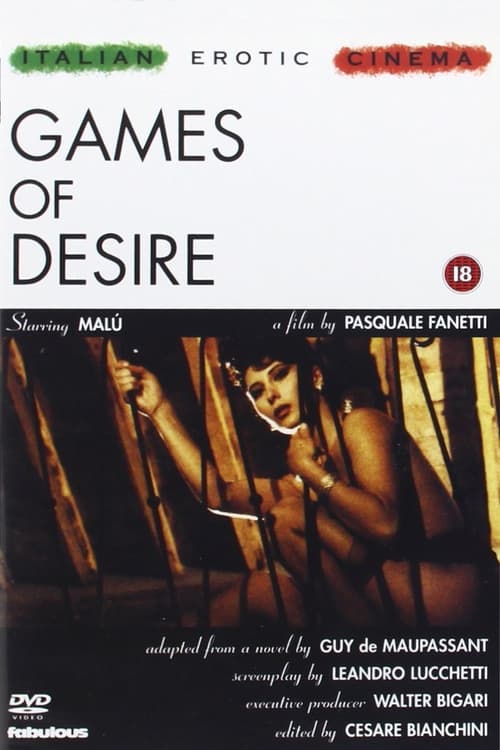
Games of Desire is a psychological drama that focuses on the deconstruction of traditional domestic structures. It succeeds in challenging traditional gender roles by centering women's ability to drive the story and presenting a fragile, psychologically complex version of masculinity. However, the film lacks meaningful visibility regarding racial and LGBTQ+ identities. While it explores unconventional interpersonal connections, these elements remain largely subtextual rather than overt. Ultimately, the film's strength lies in its challenge to the stability of the nuclear family, even if it relies on narrow casting norms common to its era.
Category Breakdown
The film explores unconventional desires and intimate relationships. Dorothy's involvement in a twisted fantasy remains unconfirmed as explicitly queer.
Florentine drives the plot through her active pursuit of affection. The film challenges traditional masculinity by showing Jake as fragile, defined by his impotence and voyeuristic fantasies.
The narrative appears to be a localized psychological study. There is no evidence of a non-white or non-Anglo-Saxon majority cast within the production.
The story deconstructs the nuclear family by framing the home as a site of distorted fantasy. It moves away from moral absolutes toward psychological relativism.
Impotency is presented as a physiological condition that catalyzes the central conflict. However, it serves more as a plot device than a nuanced exploration of disability.
Present on Screen
Limited or Absent
Official Synopsis
Florentine is a young, beautiful and passionate woman with a desire for love. Feeling abandoned by her husband's impotency, she searches for outside affection and seduction within brief, but often passionate encounters. During this web of desire she encounters Dorothy. Unknown to Florentine she is her husband's accomplice. In this twisted, frenzied fantasy her husband Jake becomes excited and aroused by the seduction of his wife. With his secret darkrooms and two-way mirrors he begins to desire his wife once more. Florentine, with the help of their adopted son, discovers his world of distorted fantasy. Amazed, but realising that Jake still loves her, she must act.
1991
1976

1997

1989
1971
1989
1974

1994
No reviews yet. Be the first to share your thoughts on this movie!
Use the rating form above to leave a star rating and optional review.