Act One
1963
No user ratings available yet
Representation score: 1.8 out of 10
Representation Score
Minimal
1959
NRDirector
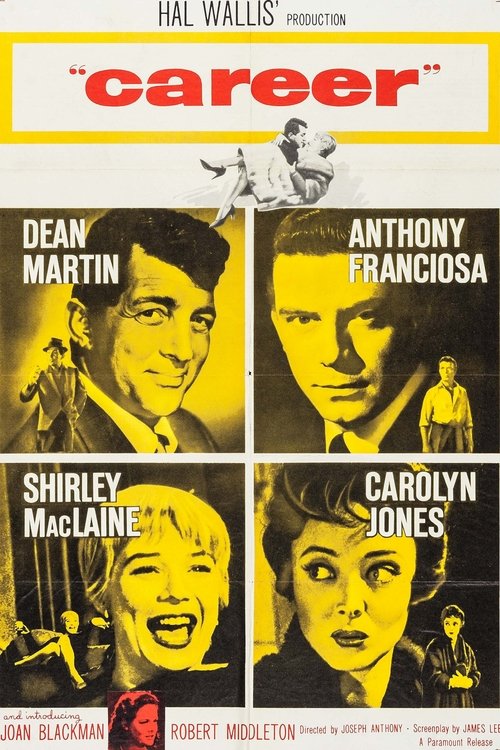
Joseph Anthony
Runtime
105 minutes
Average Rating
No ratings yetNew Showbiz Analysis
Career is a quintessential mid-century drama that prioritizes individualistic ambition over social critique. The plot is driven by the machinations of its male protagonists, leaving female characters in passive roles. The production reflects the era's standard social landscape, focusing on a homogeneous, Anglo-centric professional class. It lacks complexity or any subversion of the traditional status quo. Ultimately, the film functions as a standard character study that adheres strictly to the patriarchal and straight-centered expectations of 1959.
Category Breakdown
The film centers on a rivalry between two men over a female partner, reinforcing traditional heterosexual relationships. It does not depict any non-binary gender identities or same-sex intimacy.
The narrative emphasizes patriarchal structures where male characters dominate. Despite Shirley MacLaine being a central figure, she has little control over her own fate, serving mainly as a catalyst for male ambitions.
The story focuses on a homogeneous social group, depicting an Anglo-centric professional class without incorporating diverse racial or ethnic viewpoints.
The film upholds traditional Western values concerning ambition and the nuclear family. It uses military service as a conventional means to resolve personal conflicts.
There is no evidence of characters having visible or invisible disabilities within the narrative.
Present on Screen
Limited or Absent
Official Synopsis
Playwright James Lee adapted his off-Broadway play for the screen in this high-strung adaptation, directed by Joseph Anthony. In this simplistic, backroom show-business-success saga, Anthony Franciosa plays Sam, a struggling young actor who will forsake his family and take any type of menial job in order to become a Broadway star. Dean Martin is on hand as Maury, an aspiring director also trying to claw his way up the ladder of success. When Maury gets his big break, Sam wants a part in his show, but when Maury, who is unwilling to cast Sam in the production, turns down Sam's request, Sam seduces and marries Maury's girlfriend (Shirley MacLaine). In spite of everything, Maury wants his girl back, and Sam agrees to a divorce on the stipulation that Maury cast him as the star in his next show. Once again, Maury reneges and, before Sam can exact his revenge, Uncle Sam comes to the rescue and he is drafted into the army.
1963
1962

1958

1958
1964

1963
1964
1937
No reviews yet. Be the first to share your thoughts on this movie!
Use the rating form above to leave a star rating and optional review.