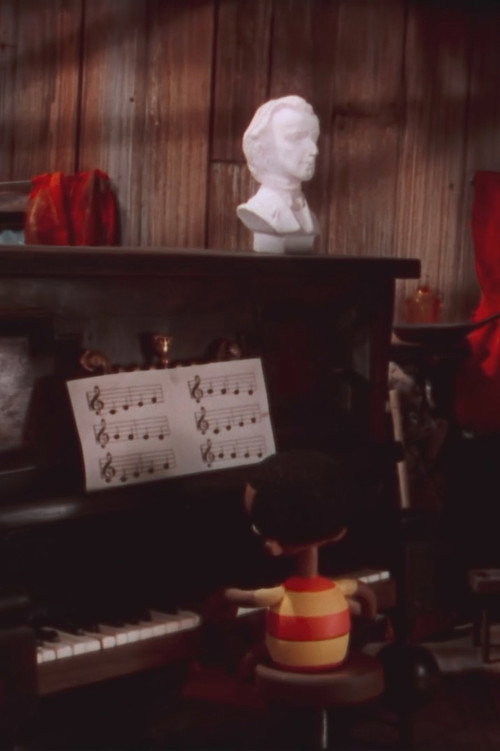
Jasper's Music Lesson
1943
No user ratings available yet
Diversity score: 3.2 out of 10

1945
ApprovedDirector
George Pal
Runtime
7 minutes
Average Rating
No ratings yetSynopsis
George Pal’s stop motion Puppetoons were peopled with all types of characters. Two of his most popular were a pair of lovestruck kids named Punchy and Judy. Here, down-on-his-luck Punchy obtains a magical straw hat from a plucky talking horse and transforms himself into Aladdin and, with the official permission of DC Comics, Superman. Hoping to impress Judy, Punchy’s delusions of grandeur only land him in jail. The talking horse is a witness at Punchy’s trial and cajoles the judge, arresting Officer Moriarty and members of the jury to test the hat, causing their secret selves to emerge inbound, a hilarious spectacle as their unfettered dreams and desire hold sway.
Overall Score
Limited
Category Breakdown
LGBTQ+ Representation
The story follows a traditional heteronormative romantic structure centered on Punchy's pursuit of Judy. No queer subtext or non-cisnormative identities are present in the narrative.
Gender Representation
Judy is portrayed as a plucky character with some agency. However, the plot relies on Punchy performing masculinity through superheroic transformations to impress her.
Racial & Ethnic Diversity
The inclusion of Aladdin utilizes an Orientalist trope common to the 1940s. The film lacks a diverse ensemble, reflecting the homogeneous casting of its era.
Religious & Cultural Diversity
The film critiques institutional authority by revealing the secret desires of a judge and jury. However, it ultimately adheres to traditional moralistic storytelling structures.
Disability Representation
There are no visible or invisible disabilities portrayed. Characters are presented through archetypal animation lenses.
Strengths
Areas for Improvement
AI Analysis
George Pal’s stop-motion short is a whimsical study of escapism and the fragility of social personas. It finds its strength in subverting authority, using a magical hat to strip away the rigid masks of judicial figures to reveal their hidden dreams. Despite this surreal disruption, the film remains anchored to the social hierarchies of 1945. The narrative relies on conventional romantic tropes and period-specific character archetypes rather than intersectional representation. Ultimately, the film uses fantasy to explore the chaos of human desire, but it does so within a framework that reinforces traditional gender roles and lacks cultural nuance.
1943
1946

1942
1945
1947

1941
1945

1944
1935

1945

1936
1941
No reviews yet. Be the first to share your thoughts on this movie!
Use the rating form above to leave a star rating and optional review.