
Racers
1972
No user ratings available yet
Diversity score: 3.1 out of 10
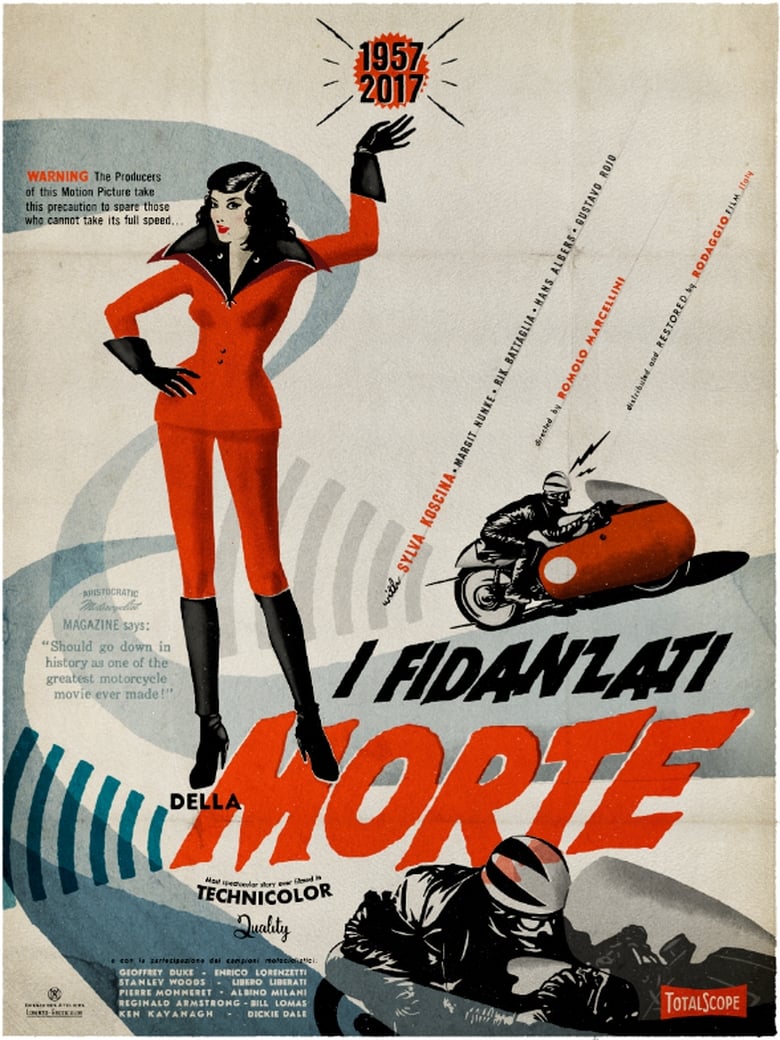
1957
GDirector
Romolo Marcellini
Runtime
93 minutes
Average Rating
No ratings yetSynopsis
A tale of love, rivalry and passion set in the 50s, in the madcap world of motorcycle speed races, shot on the occasion of the main competitions of that time, such as Monza’s Moto GP and the last edition of the legendary Milano-Taranto race. With also very rare footage of the Moto Guzzi wind tunnel and factories. The film features, alongside popular actors Rik Battaglia and Sylva Koscina, many of the most important champions of those years: Geoffrey Duke, Libero Liberati, Bill Lomas, Enrico Lorenzetti, Reg Armstrong, Stanley Woods, Ken Cavanagh, Dickie Dale, Thomas Campbell, Pierre Monneret, Albino Milani, Walter Zeller, Bruno Francisci, all of them riding amazing Moto Guzzi, Gilera, Mondial and Norton bikes with the so charming and dangerous dustbin fairings that were going to be banned in 1958.
Overall Score
Limited
Category Breakdown
LGBTQ+ Representation
The film lacks any LGBTQ+ characters or narratives. It focuses on the competitive world of motorcycle racing, which relies on traditional romantic tropes.
Gender Representation
The narrative is heavily centered on a male-dominated racing sphere. While Sylva Koscina appears in a romantic subplot, female characters serve primarily as secondary interests.
Racial & Ethnic Diversity
The cast reflects the homogeneous demographic of 1950s European motorsport. While international champions appear, there is no evidence of intentional racial blending.
Religious & Cultural Diversity
The film celebrates mid-century Western values, industrial prowess, and mechanical progress. It aligns with the era's specific cultural and technological zeitgeist.
Disability Representation
There are no visible or invisible disabilities portrayed as central to the characters or the narrative development.
Strengths
Areas for Improvement
AI Analysis
Engaged to Death is a period drama that prioritizes historical accuracy and the celebration of mid-century masculine achievement. It functions as a celebration of 1950s mechanical progress and athletic spectacle rather than a tool for social subversion. The film reflects the demographic constraints of its era, focusing on a homogeneous European sporting landscape. While it features international racing champions, it does not attempt to disrupt conventional social hierarchies or include intersectional identities. Ultimately, the work serves as a time capsule of 1957, emphasizing traditional gender roles and Western industrial pride through the lens of motorcycle racing.
1972

2015
1968
1975
1975
1954
1953

2013
1957
1974
1970
2005
No reviews yet. Be the first to share your thoughts on this movie!
Use the rating form above to leave a star rating and optional review.