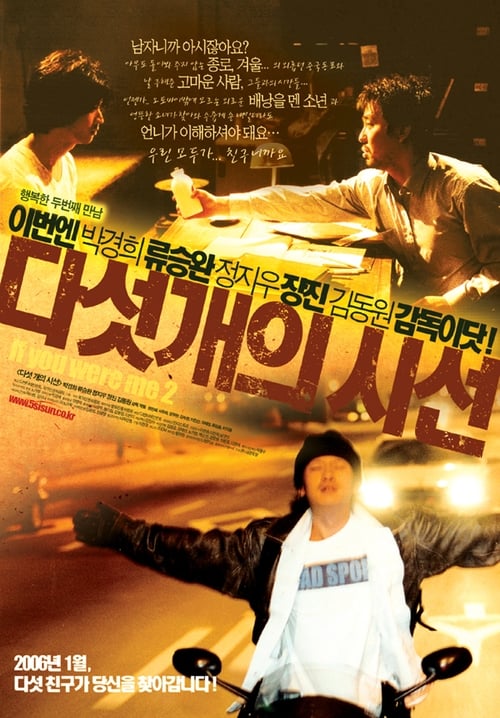
If You Were Me 2
2006
No user ratings available yet
Representation score: 8.7 out of 10
Representation Score
Excellent
2003
Not RatedDirector
Yim Soon-rye, Park Kwang-su, Yeo Kyun-dong, Jeong Jae-eun, Park Chan-wook, Park Jin-pyo
Runtime
110 minutes
Average Rating
No ratings yetNew Showbiz Analysis
This anthology serves as a sophisticated exploration of social marginalization, using six distinct perspectives to challenge conventional South Korean narratives. It excels at centering individuals often sidelined in social hierarchies. By focusing on immigrant labor, patriarchal sexism, and the experiences of disabled actors, the film provides a multifaceted critique of systemic power. However, it lacks explicit LGBTQ+ representation, limiting its inclusivity. While it avoids simple moralizing, the absence of queer narratives restricts a comprehensive examination of all social identities.
Category Breakdown
The anthology does not have explicit stories focused on LGBTQ+ characters or identities. While it explores emotions, it doesn't actively question the assumption that everyone is straight or cisgender.
Yim Soon-rye’s segment offers a sharp, witty look at sexism and patriarchal structures. The film successfully challenges traditional domestic roles by highlighting female empowerment against systemic biases.
Park Chan-wook’s segment highlights the racial prejudice and economic struggles faced by a Nepalese immigrant worker. This challenges South Korea's homogeneity by centering a non-Korean protagonist.
The film deconstructs traditional institutions and social conformity through a lens of moral complexity. It critiques capitalist drives for perfection and the rigid expectations of social institutions.
Yeo Kyun-dong’s segment features a disabled actor, Kim Moon-Joo, in a powerful re-enactment of social protest. This approach gives the character real power rather than treating disability as a subject of pity.
Present on Screen
Limited or Absent
Official Synopsis
Anthology film of six shorts by leading Korean directors. Park Chan-Wook, tackles racial prejudice and the economic exploitation of immigrant workers through the real-life story of a Nepalese woman in Korea. Jeong Jae-Eun, tackles the plight of a paedophile released into the community. Yeo Gyun-Dong, invites disabled actor Kim Moon-Joo to re-enact his most famous protest. Im Soon-Rye, goes for the engrained sexism of Korean men with superb wit and, Park Jin-Pyo, confronts the horror of children forced into oral surgery to improve their English-speaking ability.
2006
2001
2006

1956
2012

2011
2011
1996
No reviews yet. Be the first to share your thoughts on this movie!
Use the rating form above to leave a star rating and optional review.