
Genius Party Beyond
2008
No user ratings available yet
Representation score: 7.5 out of 10
Representation Score
Good
2007
Not RatedDirector
Shinji Kimura, Hideki Futamura, Masaaki Yuasa, Shinichiro Watanabe, Yoji Fukuyama, Atsuko Fukushima, Shoji Kawamori
Runtime
102 minutes
Average Rating
No ratings yetNew Showbiz Analysis
Genius Party is an experimental showcase of avant-garde animation that prioritizes stylistic fragmentation over a unified sociological framework. The anthology successfully challenges traditional anime clichés and narrative expectations through its commitment to abstraction and subjective reality. However, the focus on surrealism and dream-state logic often results in a lack of explicit identity-driven representation. While the collection embraces non-normative cognitive experiences and postmodern values, it does not provide the explicit political messaging found in contemporary media.
Category Breakdown
The anthology focuses on sensory experiences and surrealism, which means there is no clear depiction of queer identities or romantic relationships.
The films emphasize psychological abstraction over traditional roles, but they do not provide clear character arcs for female protagonists.
The collection uses a primarily Japanese perspective, and while one segment explores specific cultural aesthetics, it does not use race-bending or multi-layered casting.
The work emphasizes subjective, psychological truths over objective morality, rejecting linear storytelling and traditional institutional values.
The films explore altered states of consciousness through a child's imagination, but they do not provide explicit character-driven stories about disability.
Present on Screen
Limited or Absent
Official Synopsis
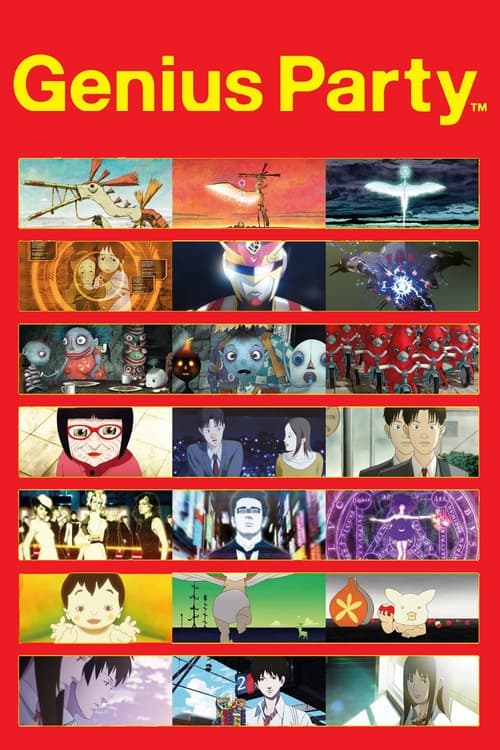
The seven short films making up GENIUS PARTY couldn’t be more diverse, linked only by a high standard of quality and inspiration. Atsuko Fukushima’s intro piece is a fantastic abstraction to soak up with the eyes. Masaaki Yuasa, of MIND GAME and CAT SOUP fame, brings his distinctive and deceptively simple graphic style and dream-state logic to the table with “Happy Machine,” his spin on a child’s earliest year. Shinji Kimura’s spookier “Deathtic 4,” meanwhile, seems to tap into the creepier corners of a child’s imagination and open up a toybox full of dark delights. Hideki Futamura’s “Limit Cycle” conjures up a vision of virtual reality, while Yuji Fukuyama’s "Doorbell" and "Baby Blue" by Shinichiro Watanabe use understated realism for very surreal purposes. And Shoji Kawamori, with “Shanghai Dragon,” takes the tropes and conventions of traditional anime out for very fun joyride.
2008
1989
1987
1995

2008
2003
2002
2003
No reviews yet. Be the first to share your thoughts on this movie!
Use the rating form above to leave a star rating and optional review.