My Big Fat Body
2009
No user ratings available yet
Diversity score: 4.1 out of 10
2018
Director
Ken Burns, Erik Ewers, Christopher Loren Ewers
Runtime
115 minutes
Average Rating
No ratings yetSynopsis
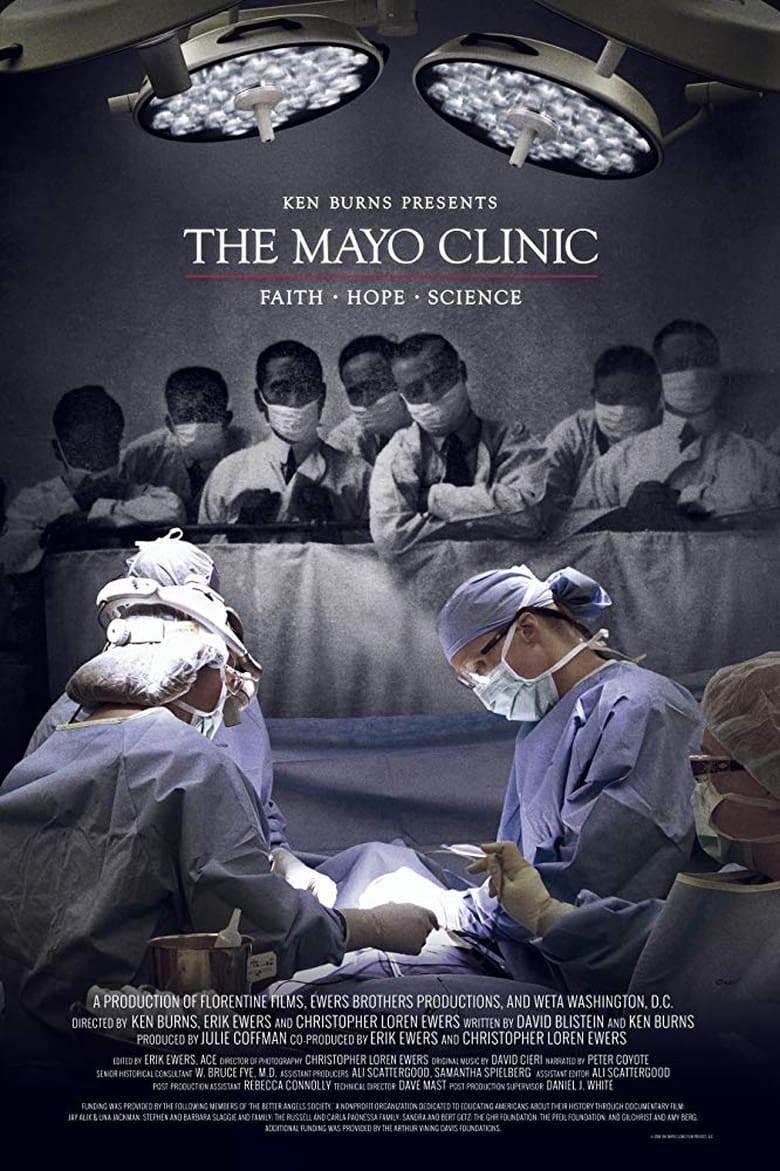
The Mayo Clinic tells the story of a unique medical institution that has been called a "Medical Mecca," the "Supreme Court of Medicine," and the "place for hope where there is no hope." The Mayo Clinic began in 1883 as an unlikely partnership between the Sisters of Saint Francis and a country doctor named William Worrall Mayo after a devastating tornado in rural Minnesota. Since then, it has grown into an organization that treats more than a million patients a year from all 50 states and 150 countries. Dr. Mayo had a simple philosophy he imparted to his sons Will and Charlie: "the needs of the patient come first." They wouldn't treat diseases...they would treat people. In a world where healthcare delivery is typically fragmented among individual specialties, the Mayo Clinic practices a multi-specialty, team-based approach that has, from its beginnings, created a culture that thrives on collaboration.
Overall Score
Limited
Category Breakdown
LGBTQ+ Representation
The film focuses on the founding families and institutional evolution. It lacks non-cisnormative gender identities or same-sex narratives, remaining consistent with a historical medical focus.
Gender Representation
The narrative disrupts the lone male physician trope by documenting women's essential contributions. It highlights female nurses and the eventual integration of women into physician ranks.
Racial & Ethnic Diversity
The documentary traces demographic shifts in staff and patients through archival footage. While acknowledging a transition toward a globalized patient base, it remains centered on Western medical models.
Religious & Cultural Diversity
This celebratory history reinforces the value of established Western medical institutions. It emphasizes professional collaboration and stability rather than critiquing institutional healthcare structures.
Disability Representation
Disability is approached through medical advancement and patient care. The film provides a platform for discussing lived experiences by focusing on the patient's agency during recovery.
Strengths
Areas for Improvement
AI Analysis
The documentary serves as a respectful, conventional historical account of a major medical institution. It succeeds in humanizing the medical process by focusing on the patient experience and the evolving roles of women in healthcare. However, the film's perspective is deeply rooted in Western institutional excellence. It prioritizes the celebration of medical progress and organizational stability over the deconstruction of traditional hierarchies or systemic medical structures. Ultimately, the representation is limited by its historical scope, resulting in a narrative that reflects the era's homogeneity while acknowledging modern demographic shifts.
2009
2012
2014

2017

1988
2018
2007

2007
2020
2020
2018

2013
No reviews yet. Be the first to share your thoughts on this movie!
Use the rating form above to leave a star rating and optional review.