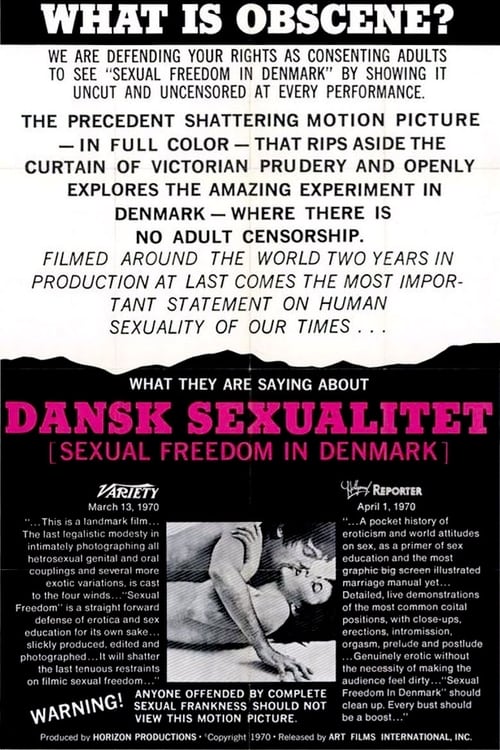
Sexual Freedom in Denmark
1970
No user ratings available yet
Representation score: 4.7 out of 10
Representation Score
Fair
1968
TV-MADirector
Gabriel Axel
Runtime
91 minutes
Average Rating
No ratings yetNew Showbiz Analysis
Gabriel Axel’s documentary serves as a historical record of Denmark's transition toward a more secular and liberalized society. It focuses on the breakdown of institutional authority and the dismantling of censorship laws. The film excels in its exploration of individual freedom and the deconstruction of traditional social hierarchies. However, the work lacks diversity in its cast, reflecting the homogeneity of the time period.
Category Breakdown
The film discusses the legal barriers that hindered queer visibility in the mid-20th century. It critiques the assumption that everyone is straight or cisgender, highlighting the restrictive nature of those laws.
The narrative emphasizes the disruption of male-dominated control over media. The removal of censorship is tied to the growing feminist movement and the reclaiming of bodily autonomy.
The content reflects the demographic uniformity of Denmark in 1968. There is no indication of significant racial diversity or the overlapping aspects of identity.
The work documents the decline of state-imposed morality. It highlights a move toward secularism and the critique of religious or state-imposed moral hierarchies.
There is insufficient evidence to determine the portrayal of disability.
Present on Screen
Limited or Absent
Official Synopsis
A look at what happened when Denmark abolished censorship in the late 1960s.
1970

1965
1976

1971
1999

2012

2006
1989
No reviews yet. Be the first to share your thoughts on this movie!
Use the rating form above to leave a star rating and optional review.