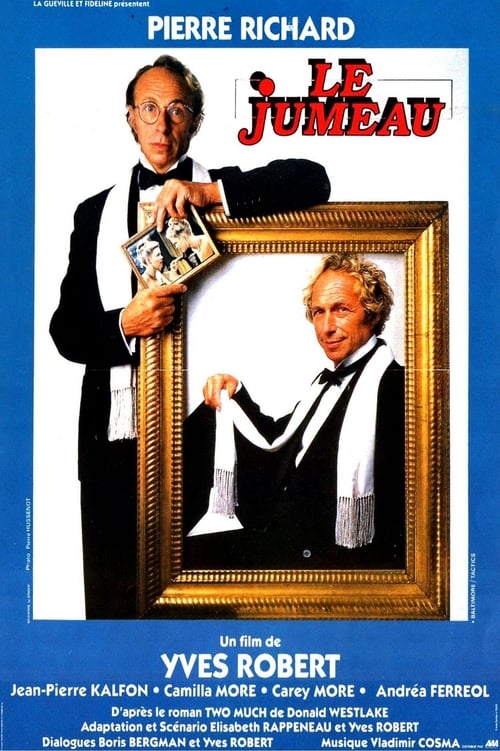
The Twin
1984
No user ratings available yet
Diversity score: 2.6 out of 10

2015
Director
Isabel Kleefeld
Runtime
88 minutes
Average Rating
No ratings yetSynopsis
By-the-book logopaedist Matthias Pretschke, failed husband and father, is the very embodiment of order, who doesn't know what hit him when his wife Petra demands a divorce. Admittedly, he hasn't paid much attention to Petra, nor to their daughter, who's in full puberty, nor to their son, who craves his dad's attention. Petra agrees to give him one week to show them if he can change. And he's in luck: he meets himself, only cooler. Tom Senger is the name of the twin he never knew he had. Though Matthias and Tom look alike, they're completely different. Tom, for example, is a typical actor: arrogant, macho and broke. Matthias decides to switch roles in the hope that Tom can be a worthy replacement for a week. "I'm playing you. Only better," says Tom, who sees right away what's missing in the Pretschke home. As the days go by, it gets more and more difficult to distinguish which one is which. And this may not be bad at all.
Overall Score
Fair
Category Breakdown
LGBTQ+ Representation
The narrative focuses on a heteronormative family unit in crisis. There is no evidence of queer identities or non-cisnormative characters within the central plot.
Gender Representation
The film disrupts domestic hierarchies by centering Petra's agency in the divorce. It subverts patriarchal tropes by portraying the male lead as a failed provider and deconstructing masculine archetypes through Tom.
Racial & Ethnic Diversity
The story centers on a homogeneous family structure. There is no indication of a multi-ethnic cast or the use of diverse casting to expand the narrative scope.
Religious & Cultural Diversity
The plot deconstructs the Western nuclear family by framing rigid domestic order as a failure. It prioritizes individual identity and reconfiguration over traditional family stability.
Disability Representation
The film provides no information regarding characters with visible or invisible disabilities or neurodivergence. No assessment of disability representation can be made.
Strengths
Areas for Improvement
AI Analysis
The film operates primarily as a domestic deconstruction piece. It finds its footing by challenging the competence of traditional masculine leadership and the perceived sanctity of the nuclear family. However, the work lacks significant breadth in terms of intersectional identity. The narrative remains largely confined to conventional Western demographic norms, offering little engagement with queer or multi-ethnic perspectives. Ultimately, the film's diversity is narrow, focusing on the subversion of gendered domestic roles rather than a broad spectrum of human experience.
1984

2015
2019

2016

2009

2017

2010

2020

2018

1988

2018

2020
No reviews yet. Be the first to share your thoughts on this movie!
Use the rating form above to leave a star rating and optional review.