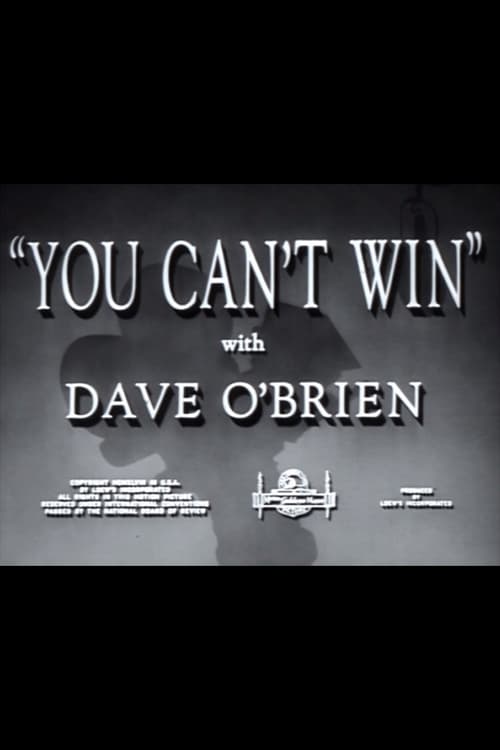
You Can't Win
1948
No user ratings available yet
Diversity score: 1.3 out of 10

1950
NRDirector
Dave O'Brien
Runtime
10 minutes
Average Rating
No ratings yetSynopsis
This Pete Smith Specialty short was produced in cooperation with the U.S. Department of Labor. Using humor, it shows what can happen when tools and machinery are misused and safety warnings are ignored.
Overall Score
Minimal
Category Breakdown
LGBTQ+ Representation
The film contains no LGBTQ+ characters or narratives. It focuses exclusively on mechanical and occupational themes.
Gender Representation
The production likely relies on traditional gender roles common to the 1950s industrial era. There is no evidence of non-traditional masculinity or subverted hierarchies.
Racial & Ethnic Diversity
The film reflects the demographic homogeneity of the mid-century American workforce. It lacks intersectional casting or any disruption of Anglo-centric norms.
Religious & Cultural Diversity
The narrative reinforces Western institutional values by emphasizing compliance with authority and safety regulations. It serves to uphold industrial stability rather than critique it.
Disability Representation
Physical impairment is used as a cautionary plot device to show the consequences of negligence. Characters lack agency, as injury serves only to illustrate mechanical misuse.
Strengths
Areas for Improvement
AI Analysis
Wrong Way Butch is a didactic instructional comedy produced in cooperation with the U.S. Department of Labor. Its primary goal is to promote workplace safety through slapstick humor, which inherently prioritizes institutional order over social complexity. Because the film functions as a tool for labor safety, it reinforces established procedural norms and mid-century social hierarchies. The narrative structure is tied to the preservation of industrial stability rather than the exploration of diverse identities. Ultimately, the film lacks the intentionality required to engage with intersectional perspectives, serving instead as a period-specific reinforcement of traditional American workforce demographics and values.
1948
1951
1953
1955
1953
1947

1950
1954
1954
1948
1949
1954
No reviews yet. Be the first to share your thoughts on this movie!
Use the rating form above to leave a star rating and optional review.