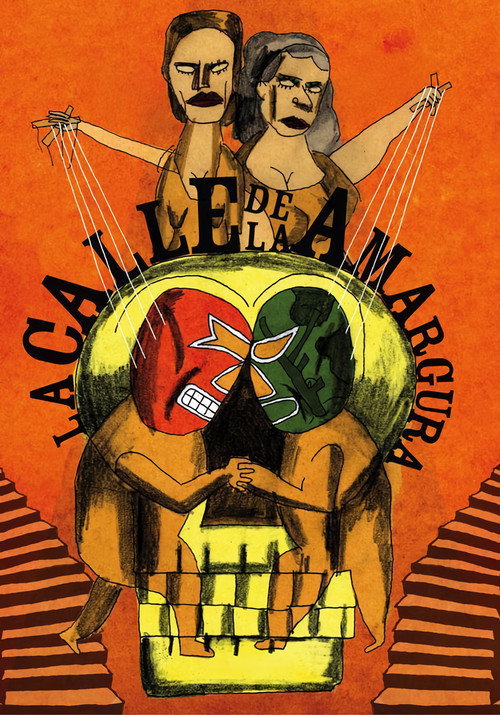
Bleak Street
2015
No user ratings available yet
Diversity score: 6.9 out of 10

2006
Director
Arturo Ripstein
Runtime
119 minutes
Average Rating
No ratings yetSynopsis
In a seedy brothel, their frustrations parade: A poet who has never published, a revolutionary who came late to history, a provocative angel, a bureaucrat with delusions of a dancer, a greedy Chinese man and his timorous wife, Monica, a prostitute with low professional esteem, a group of prostitutes of dubious sensuality and, finally, a priest with a stench of holiness and another with redeeming instincts. But a stranger with the air of a princess appears, and upsets the balance of the establishment.
Overall Score
Good
Category Breakdown
LGBTQ+ Representation
The film explores non-normative identities and desires within the liminal space of a brothel. It critiques heteronormative structures by centering characters whose sexualities exist in tension with traditional social expectations.
Gender Representation
Women act as central agents of disruption within a male-dominated, decaying environment. Characters like Monica provide a nuanced look at female agency and the complexities of survival outside patriarchal stability.
Racial & Ethnic Diversity
The cast features a heterogeneous mix, including a greedy Chinese man and his wife. This avoids a homogeneous social order by highlighting the intersection of ethnicity and economic desperation.
Religious & Cultural Diversity
The narrative deconstructs religious authority by presenting priests with conflicting moral instincts. It functions as an anti-capitalist critique, focusing on those discarded by the economic and social mainstream.
Disability Representation
There is no explicit evidence regarding the portrayal of physical or neurodivergent disabilities in the narrative.
Strengths
Areas for Improvement
AI Analysis
Arturo Ripstein’s film serves as a profound deconstruction of social stability, using a seedy brothel to examine institutional decay. The ensemble cast represents a spectrum of characters existing outside the boundaries of respectable society, challenging the sanctity of the church and state. The film excels at subverting traditional hierarchies and religious authority. By presenting a landscape of subjective morality, it rejects singular truths in favor of a complex, postmodern examination of marginality. While the film offers a sophisticated critique of Western institutions and gender roles, it lacks specific information regarding disability representation.
2015

2001
2000

2002
1994

2019
1997
2003
2002
2014
2005
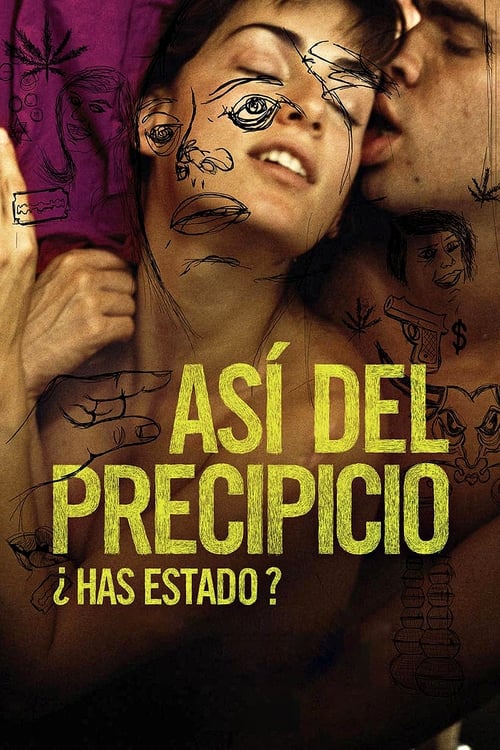
2006
No reviews yet. Be the first to share your thoughts on this movie!
Use the rating form above to leave a star rating and optional review.