
Dreams
1993
No user ratings available yet
Representation score: 3.2 out of 10
Representation Score
Fair
1988
Director
Vladimir Khotinenko
Runtime
139 minutes
Average Rating
No ratings yetNew Showbiz Analysis
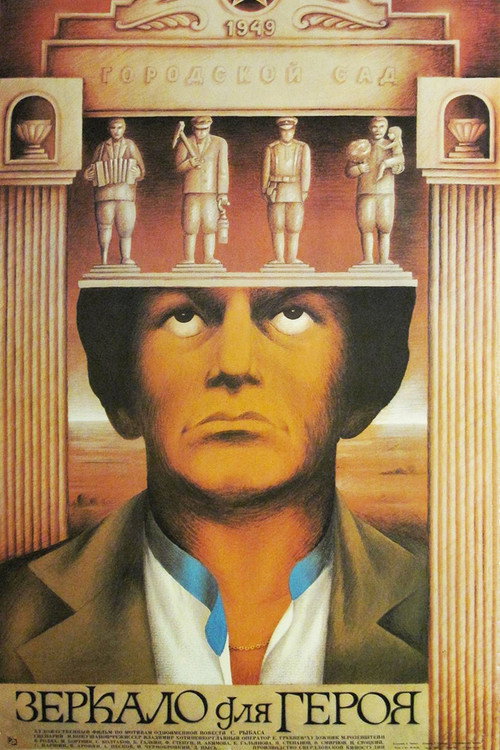
Mirror for a Hero is a metaphysical exploration of memory that emphasizes psychological depth over social commentary. By trapping its protagonists in a repetitive post-WWII loop, the film focuses on the individual's relationship with history rather than diverse identity narratives. The narrative adheres strictly to the demographic and social realities of the late 1940s Soviet Union, resulting in a homogeneous cast and a lack of diverse identity narratives. Ultimately, the film's strength lies in its innovative non-linear structure and its use of time loops as metaphors for human consciousness.
Category Breakdown
The film follows a traditional mid-century Soviet social framework. There is no indication of non-traditional gender identities or stories that question the assumption that everyone is straight or cisgender.
The story centers around the psychological journeys of male characters Sergei and Andrei. Women appear in historical scenes but are constrained by the social norms of the 1949 setting.
The film portrays a relatively uniform Soviet society typical of the era. The cast reflects the standard demographic makeup of the Soviet Union in the late 1940s.
The narrative explores the tension between personal truth and the collective historical record. It focuses on the metaphysical experience of time rather than specific critiques of institutions.
There is no significant presence of characters with visible or invisible disabilities playing central roles. The film uses time loops as a metaphor for memory rather than disability.
Present on Screen
Limited or Absent
Official Synopsis
Sergei and Andrei are walking through a city park and see that a film shoot set just post World War II is taking place . They climb over the park fence to get a better view but hit some cable lying on the ground and find themselves in the past - on May 8, 1949, a day which they seem doomed to relive over and over again.
1993

1968
1993
1973
1969
1972

2001
1993
No reviews yet. Be the first to share your thoughts on this movie!
Use the rating form above to leave a star rating and optional review.