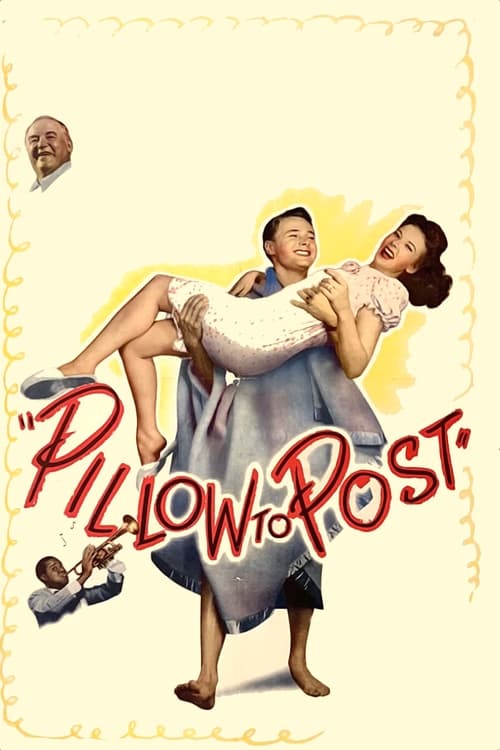
Pillow to Post
1945
No user ratings available yet
Representation score: 1.6 out of 10

Representation Score
Minimal
1946
PassedDirector
Vincent Sherman
Runtime
89 minutes
Average Rating
No ratings yetNew Showbiz Analysis
*Janie Gets Married* opens in the polished, black-and-white comfort of the Conway household, a space where wealth and propriety are the default setting. The film’s argument is simple: the disruption of a new marriage is a temporary inconvenience that the established family will ultimately absorb. Janie Conway, the blonde American Girl, is the engine of the plot, scheming to place her husband in her father’s newspaper. Yet her competence is not a challenge to the status quo; it is a tool to secure the union. The camera loves her, framing her as wholesome and moral, but it ultimately bills her success as a return to domestic order. The tension lies in the father, Charles Conway, who represents the old money establishment. He is the obstacle, but he is not the villain. His rigidity is treated as a character flaw to be corrected, not a moral failing to be punished. When he is won over, the film affirms the value of the family unit over individual ambition. The "outsider" is Sgt. Spud Lee, a WAC whose roughness and military bearing are played for laughs against the Conways’ polish. She is the joke, a reminder of the world outside the domestic sphere, but she is ultimately contained by the narrative’s focus on the newlyweds. The last image is a warm embrace between Janie and Dick, signaling the restoration of order. The film sells the legend of the wholesome American marriage, where the good couple wins and the stern father is softened. It does not critique the class or gender dynamics it presents; it treats them as normal. The sold meaning is that the traditional family is the ultimate good, and any deviation is a problem to be solved by love and acceptance. The film is a product of its time, reflecting the post-war desire for stability and the reaffirmation of traditional roles. It is a simple, unchallenging narrative that rewards the audience with a return to the familiar.
Category Breakdown
Absent. The narrative relies on heterosexual pairings and gendered military roles without depicting same-sex intimacy. Sgt. Spud Lee’s presence functions as a gendered comic beat rather than an identity exploration.
Janie schemes to secure her husband’s career, yet the film resolves her agency through marriage. Sgt. Spud Lee is framed as a rough outsider whose military bearing contrasts with the polished domestic ideal. The ending restores the nuclear unit as the moral center.
Absent. The cast is entirely white, reflecting the unmarked majority of 1946 studio productions. No racial dynamics or non-white perspectives are depicted or discussed within the narrative.
The Conway family’s wealth and status are treated as the default normal. Father Charles Conway serves as a rigid obstacle who is eventually won over, affirming the value of established family structures. The ending rewards the restoration of traditional domestic order.
Absent. No characters are depicted with physical, sensory, or cognitive impairments. The narrative does not engage with disability as a theme or character trait.
Present on Screen
Limited or Absent
Official Synopsis
Newlywed Janie's (Joan Leslie) World War II-veteran husband (Robert Hutton) goes to work at her father's (Edward Arnold) newspaper.
1945
1944
1945
1949
1946
1949
1942
1944
No reviews yet. Be the first to share your thoughts on this movie!
Use the rating form above to leave a star rating and optional review.