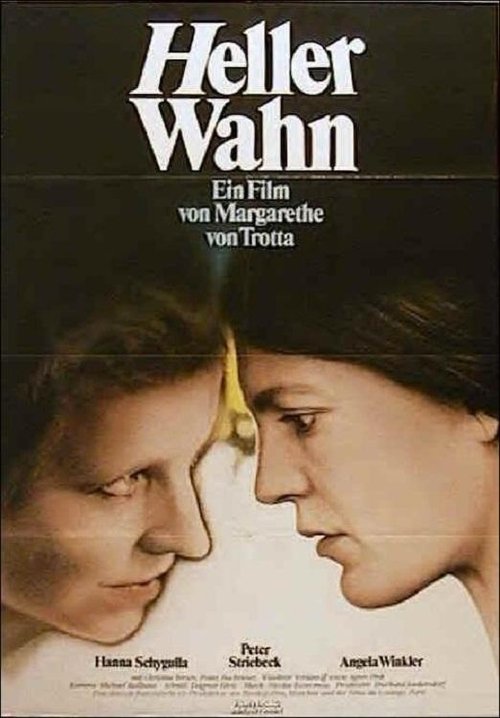
Sheer Madness
1983
No user ratings available yet
Diversity score: 5.5 out of 10

1979
Not RatedDirector
Margarethe von Trotta
Runtime
95 minutes
Average Rating
No ratings yetSynopsis
Sisters Maria and Anna live together. Maria is a most proficient executive secretary, encouraging Anna to finish her studies and start a career. Anna broods, threatens to quit university, takes pills, and keeps a diary. When Maria's relationship with Maurice, the son of her boss, starts to lead to love, Anna takes a selfish and drastic step that plummets Maria into solitude. No longer able to connect with Maurice, Maria does establish a relationship with Miriam, a typist at her office who becomes a surrogate younger sister. But Maria is intrusive as well as helpful. Can this or any relationship work out for this talented woman whose past seems to choke her soul?
Overall Score
Fair
Category Breakdown
LGBTQ+ Representation
The film disrupts heteronormative expectations by shifting the protagonist's focus from a male romantic interest to an intimate bond with Miriam. This transition suggests a nuanced exploration of female-centric emotional sanctuaries.
Gender Representation
The narrative centers entirely on female agency and intellect, prioritizing complex interpersonal dynamics between women. It successfully challenges historical trends by making women the primary drivers of both professional success and psychological conflict.
Racial & Ethnic Diversity
The film focuses on a homogeneous West German social milieu. There is no evidence of significant racial or ethnic diversity within the primary cast, reflecting the era's localized social focus.
Religious & Cultural Diversity
The story explores personal truth and individual autonomy rather than religious or patriotic institutions. It prioritizes the characters' psychological states over traditional Western social cohesion or familial duty.
Disability Representation
Mental health and psychological fragility are central to the character arcs, particularly through Anna's existential distress. However, these elements serve as plot drivers rather than a dedicated exploration of disability agency.
Strengths
Areas for Improvement
AI Analysis
Margarethe von Trotta delivers a sophisticated feminist work that centers female subjectivity and deconstructs patriarchal structures. The film excels by placing women at the heart of both professional competence and profound psychological struggle. While the film lacks racial and ethnic diversity, it compensates with a high-level subversion of gender hierarchies. The narrative moves away from male-driven mechanics to explore the complex, often fraught, relationships between women. The exploration of non-heteronormative intimacy and individual autonomy provides a progressive lens. It prioritizes personal psychological truth over established social or religious norms, making it a significant piece of New German Cinema.
1983
1977

1998
2012
1993

1972

2013

1975

1969

2017

1987

2014
No reviews yet. Be the first to share your thoughts on this movie!
Use the rating form above to leave a star rating and optional review.