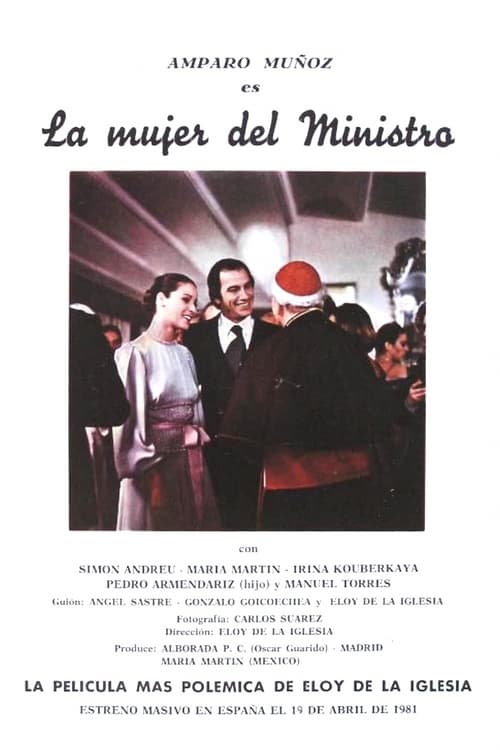
The Minister's Wife
1981
No user ratings available yet
Representation score: 6.3 out of 10
Representation Score
Good
1978
UnratedDirector
Eloy de la Iglesia
Runtime
106 minutes
Average Rating
No ratings yetNew Showbiz Analysis
Eloy de la Iglesia uses this drama to explore the tension between personal freedom and state power. The film stands out by questioning the sanctity of political institutions and focusing on the complexities of individuals' private lives. By examining how power, sexuality, and political identity intersect, it offers a modern critique of established social hierarchies. However, the film remains limited by the demographic homogeneity of its setting, which reflects the specific socio-political context of the Spanish Transition.
Category Breakdown
The film challenges traditional views by focusing on the intersection of sexual identity and political power. It uses subtle hints to question the assumption that everyone is straight or cisgender, highlighting the complexity of political authority during the post-Franco period.
The story overturns conventional ideas by breaking down the stereotype of the stable male leader. It presents a protagonist whose personal weaknesses and unconventional desires complicate his public role.
The cast is primarily made up of people from similar backgrounds, reflecting the demographics of the Spanish political class during this time. There is no significant blending of races or casting actors from diverse backgrounds.
The film effectively critiques traditional Western institutions through a narrative that questions moral absolutes. It portrays the political establishment as a place of corruption and changing social hierarchies.
There is no information available to assess the portrayal of visible or invisible disabilities in the film.
Present on Screen
Limited or Absent
Official Synopsis
Roberto, a leader and follower of the ideals of his radical leftist opposition party, can’t resist the cheap beautiful street teenagers that are thrown his way for various pleasures.
1981

1973
1977
1987
1980

1985
1981
1978
No reviews yet. Be the first to share your thoughts on this movie!
Use the rating form above to leave a star rating and optional review.