I Love You, Alice B. Toklas!
1968
No user ratings available yet
Representation score: 3.1 out of 10
Representation Score
Fair
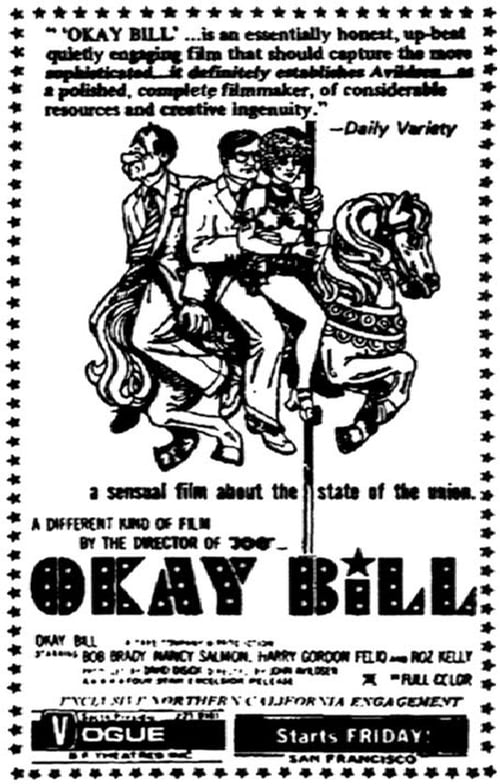
1971
RDirector
John G. Avildsen
Runtime
91 minutes
Average Rating
No ratings yetNew Showbiz Analysis
Okay Bill acts as a cultural time capsule, capturing the tension between traditional 1970s stability and the emerging counterculture. It successfully challenges some gendered expectations through Nancy's autonomy and offers a critique of capitalist emptiness. However, the film's depth is limited by a lack of multi-layered diversity. The focus remains heavily on a homogeneous middle-class experience, leaving significant gaps in racial and disability representation. Ultimately, while the film explores social shifts and non-traditional value systems, it relies more on cultural proximity to underrepresented groups than on deep, integrated representation.
Category Breakdown
The film touches on non-straight social circles through characters like Gordon and the Fire Island setting. However, it doesn't explicitly depict queer identities or romantic relationships, offering proximity to subcultures rather than meaningful representation.
Nancy stands out as a liberated figure who challenges mid-century domestic ideals through her sexual freedom and independent political interests. Although the film ultimately reinforces her marriage, her character evolves towards a more autonomous archetype.
The narrative centers on a homogeneous middle-class demographic within the 1970s counterculture. There is no evidence of diverse casting or intentional racial blending in the story.
The film critiques capitalist stability and conventional success by contrasting stockbroker life with the hippie movement. It engages with era-specific values like ecological awareness and the deconstruction of Western institutions.
There are no visible or invisible disabilities depicted within the primary character arcs.
Present on Screen
Limited or Absent
Official Synopsis
The film tells the story of Bill, a young, successful stockbroker who zips off to Greenwich Village on his motorcycle when no one's looking to venture into the hippy counterculture world. His wife, Nancy, is the dream of every middle-class male. She is liberated enough to go around bra-less, enjoy sex, and be the perfect mother for their child. Nancy, however, is unaware of her husband's excursions and happily attends the local ecology awareness meetings without Bill. Bill soon becomes involved with Gordon, an Andy Warhol-type character whose protege, Roz, fascinates the square young businessman. After witnessing a wild party on Fire Island, Bill realizes that this crowd is not for him (shallow, lifeless) and that he does not even want to have sex with Roz because he is lonely for his wife. Nancy arrives unexpectedly on the island to reclaim her husband and together they walk off into the sunset hand in hand.
1968
1969
1973
1966
1972
1971
1970
1970
No reviews yet. Be the first to share your thoughts on this movie!
Use the rating form above to leave a star rating and optional review.