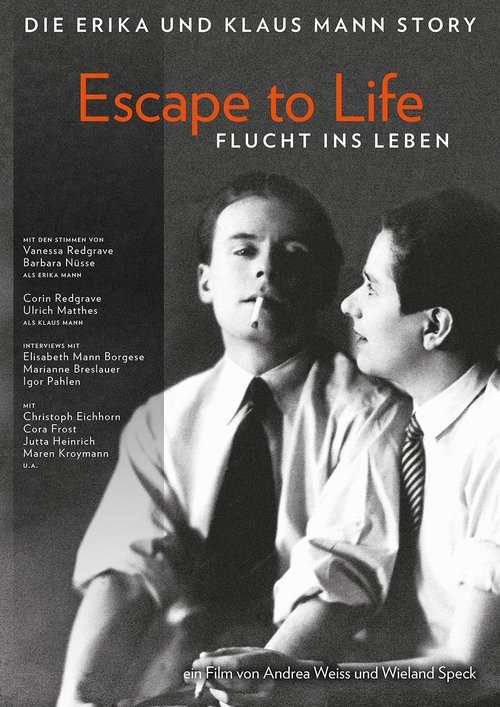
Escape to Life: The Erika and Klaus Mann Story
2001
No user ratings available yet
Representation score: 6.3 out of 10
Representation Score
Excellent
1978
Director
Hans Peter Cloos, Maximiliane Mainka, Rainer Werner Fassbinder, Alexander Kluge, Beate Mainka-Jellinghaus, Alf Brustellin, Katja Rupé, Volker Schlöndorff, Edgar Reitz, Bernhard Sinkel, Peter Schubert
Runtime
123 minutes
Average Rating
No ratings yetNew Showbiz Analysis
Germany in Autumn is a radical, fragmented essay film that deconstructs West German identity during a period of intense political crisis. It replaces traditional, state-sanctioned narratives with a complex, postmodern collage of perspectives. The film excels in cultural and queer representation, using the challenging lens of directors like Fassbinder to question institutional stability and straight-centered social structures. This provides a necessary critique of the era's power dynamics. However, the work is limited by its specific historical and geographic context. It primarily reflects a largely homogeneous European intellectual landscape, lacking significant racial diversity or focus on disability.
Category Breakdown
Rainer Werner Fassbinder's contributions bring in-depth insights into queer lifestyles within artistic communities. His segments challenge the assumption that everyone is straight or cisgender by showcasing non-assuming gender matches what was assigned at birth lives.
A diverse group of male and female directors avoid a single patriarchal storyline. Their multi-vocal approach explores gendered social hierarchies and female perspectives during times of political turmoil.
The film reflects a predominantly white West German demographic. It lacks intentional representation of non-white groups, serving mainly as a mirror of a specific European environment.
The film offers a deep critique of West German capitalism and state authority. It avoids state-sanctioned morality, presenting the political status quo as a source of division.
There is minimal focus on visible or invisible disabilities. The film prioritizes political ability to act and national identity over the lived experiences of neurodivergence or physical disabilities.
Present on Screen
Limited or Absent
Official Synopsis
Nine fictitious documentaries and films reflect the mood of late 1970s Germany, particularly the two-month period in 1977 when a businessman was kidnapped by the RAF (Red Army Faction). The kidnap had been made to orchestrate the release of the original leaders of the RAF, aka the Baader-Meinhof.
2001
2003
2002

2008
1986

2010
2001
1975
No reviews yet. Be the first to share your thoughts on this movie!
Use the rating form above to leave a star rating and optional review.