
One Day
2017
No user ratings available yet
Representation score: 4.9 out of 10
Representation Score
Limited
1999
Director
Song Hae-sung
Runtime
98 minutes
Average Rating
No ratings yetNew Showbiz Analysis
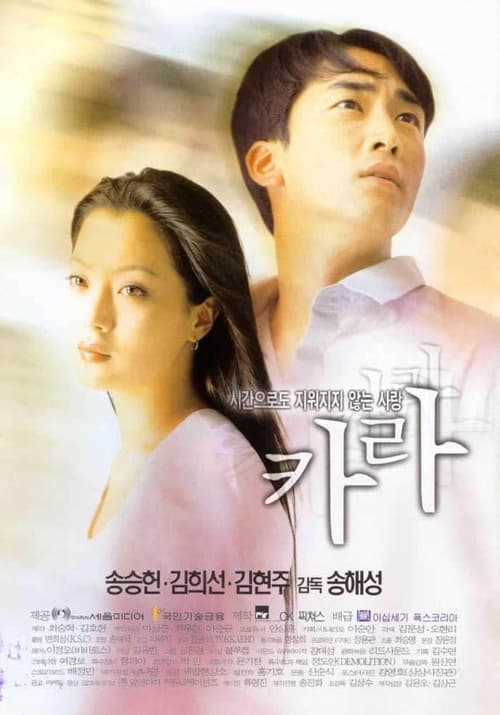
Calla (1999) is a genre-driven drama that relies heavily on established romantic clichés and sudden tragedy. While it offers a non-Western perspective through its South Korean origin, the storytelling remains within conventional bounds. The film lacks intentionality in disrupting social hierarchies or promoting diverse identities. The narrative structure focuses on a traditional romantic pursuit that ends in violence, rather than exploring complex social or systemic critiques. Ultimately, the representation is limited by a reliance on standard dramatic frameworks, providing a culturally specific lens without broader progressive diversity.
Category Breakdown
The film focuses on a heterosexual relationship between Seon-woo and Ji-hee. It does not include any non-straight or non-cisgender identities or critiques of heterosexuality.
Ji-hee plays a key role in the male lead's emotional journey. However, her role is defined by her relationship to him and her status as a victim.
As a South Korean production, the film features a non-Western cast. There is insufficient detail about specific ethnic subgroups or diverse character identities.
The narrative follows a conventional emotional arc centered around tragic romance. It does not explicitly address traditional institutions or systemic power structures.
There is no mention of characters with visible or invisible disabilities in the narrative.
Present on Screen
Limited or Absent
Official Synopsis
Seon-woo receives calla every morning and wants to find out who the secret admirer is. One day, he goes to a nearby florist's where he meets Ji-hee. He falls in love with her at first sight, thinking she is the one who is sending him flowers. Seon-woo asks Ji-hee to go on a date and she agrees. He arrives at the rendenvous only to find that Ji-hee is held hostage and, to his horror, killed before his eyes.
2017
1999
2026
2007
2005
2011

2016
2010
No reviews yet. Be the first to share your thoughts on this movie!
Use the rating form above to leave a star rating and optional review.