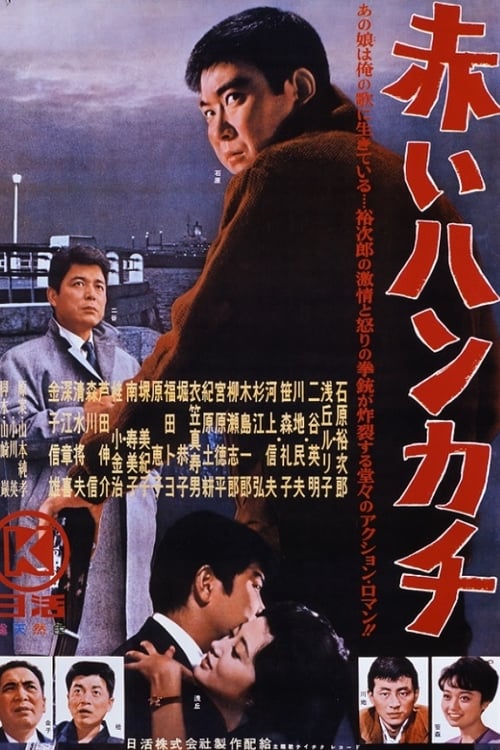
Red Handkerchief
1964
No user ratings available yet
Diversity score: 3.4 out of 10

1958
Director
Toshio Masuda
Runtime
90 minutes
Average Rating
No ratings yetSynopsis
Udaka is a new, post-war city where corruption has already taken hold. A persistent district attorney wants to arrest and convict Katsumata, a laughing, self-confident thug. The D.A. gets an anonymous letter about the suicide five years' before of a city council member. Evidence about the case leads the D.A. to Tachibana, struggling to go straight after involvement with the mob and a prison sentence for killing the man responsible for the rape and suicide of his fiancée. One of Tachibana's friends is Keiko, the daughter of the dead councilman and the ward of another powerful official. How do these stories connect?
Overall Score
Limited
Category Breakdown
LGBTQ+ Representation
The film operates within the traditional social frameworks of 1958. There is no evidence of non-heteronormative identities or narratives critiquing heteronormativity.
Gender Representation
Keiko occupies a central role, yet her agency is tied to patriarchal structures as a ward of an official. The film does address gendered victimization through the lens of sexual violence.
Racial & Ethnic Diversity
The story depicts a culturally homogeneous society typical of the Japanese studio system. It focuses on internal class and power dynamics rather than multi-ethnic casting.
Religious & Cultural Diversity
The narrative critiques the corruption of Western-style institutions and formal authority. It portrays the state as a compromised actor rather than an inherently moral one.
Disability Representation
There is no documented evidence of characters navigating physical or neurodivergent disabilities. The narrative does not feature disability-centric storylines.
Strengths
Areas for Improvement
AI Analysis
Toshio Masuda’s crime thriller functions as a post-war social critique, focusing on the friction between individual agency and systemic corruption. The film prioritizes the deconstruction of institutional authority over modern demographic intersectionality. While the film lacks diverse identity-based representation, it offers a progressive skepticism of the 'system.' It uses the crime genre to examine how personal trauma and moral relativism respond to a failed social contract.
No reviews yet. Be the first to share your thoughts on this movie!
Use the rating form above to leave a star rating and optional review.