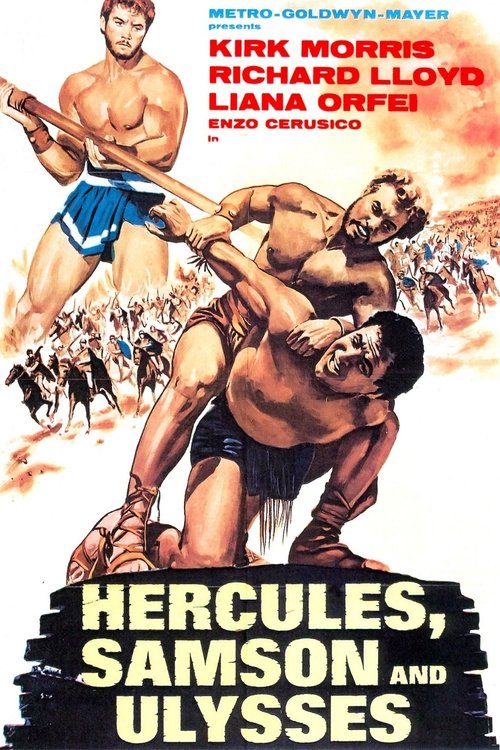
Hercules, Samson & Ulysses
1963
No user ratings available yet
Diversity score: 1.5 out of 10

1961
Director
Richard Pottier
Runtime
98 minutes
Average Rating
No ratings yetSynopsis
The classic story from the early days of Rome where there are no women. Romulus, the founder of Rome, finds women to be wives from Sabina where there are a lot of women. The Sabine men, of course, attack Rome to get their wives and daughters back.
Overall Score
Minimal
Category Breakdown
LGBTQ+ Representation
The film focuses on the foundational myth of Roman lineage and patriarchal structures. It contains no non-cisnormative identities or narratives that challenge heteronormative frameworks.
Gender Representation
Male agency drives the plot, specifically through the leadership of Romulus. Women are depicted as objects of conflict to be acquired rather than autonomous participants in the political landscape.
Racial & Ethnic Diversity
Casting reflects the homogeneous European aesthetic typical of mid-century productions. While Romans and Sabines are distinct groups, the visual representation adheres to standard 1960s casting norms.
Religious & Cultural Diversity
The story celebrates Western mythos and the establishment of a singular state through conquest. It emphasizes traditional institutions like family and state without offering moral relativism.
Disability Representation
There is no discernible focus on neurodivergence, physical disabilities, or chronic illness. Characters function within standard physical archetypes of the adventure genre.
Strengths
Areas for Improvement
AI Analysis
Romulus and the Sabines functions as a traditional historical epic that reinforces conventional social and power hierarchies. The narrative is built entirely upon male agency and the preservation of classical Western foundational myths. The film adheres to the period-specific norms of mid-century European cinema. It prioritizes established social structures and traditional leadership models rather than exploring intersectional identities or subverting classical roles. Ultimately, the production serves to uphold historical continuity and the rise of Rome as a standard progression of civilization, offering little room for diverse perspectives.
1963
1979
1947
1964
1951

1947
1960
1950
1964
1961
1960
1961
No reviews yet. Be the first to share your thoughts on this movie!
Use the rating form above to leave a star rating and optional review.