
The Animal People
2019
No user ratings available yet
Representation score: 3.7 out of 10
Representation Score
Fair
2011
Director
Gerald Igor Hauzenberger
Runtime
116 minutes
Average Rating
No ratings yetNew Showbiz Analysis
The Trial primarily serves as a political critique rather than a study of demographic diversity. Its strength lies in its thematic deconstruction of state authority and the portrayal of individual resistance against systemic oppression. By focusing on the legal battle of Sabine Koch, the film challenges the legitimacy of established hierarchies. However, the documentary lacks breadth in traditional representation. The focus on a localized Austrian context results in low scores for racial and ethnic diversity. Additionally, there is no visible focus on LGBTQ+ identities or disability representation. Ultimately, the film's value is found in its progressive interrogation of democracy and justice. It prioritizes the scrutiny of institutional power over the inclusion of diverse social identities.
Category Breakdown
The film emphasizes political and legal activism rather than personal stories of LGBTQ+ individuals. It does not include any characters with non-cisgender identities or explicitly mention LGBTQ+ issues.
Sabine Koch is a key female character who plays a significant role in driving the story. She challenges traditional hierarchies where men are often the main political actors.
The documentary centers on localized Austrian legal proceedings. The setting appears culturally homogeneous, lacking evidence of diverse racial or ethnic casting.
The film critically examines Western institutions, portraying the state and justice system as potentially oppressive. It highlights how anti-terrorism laws can be used to silence dissent.
There is no evidence that disability, neurodivergence, or chronic illness are central themes or character traits in this work.
Present on Screen
Limited or Absent
Official Synopsis
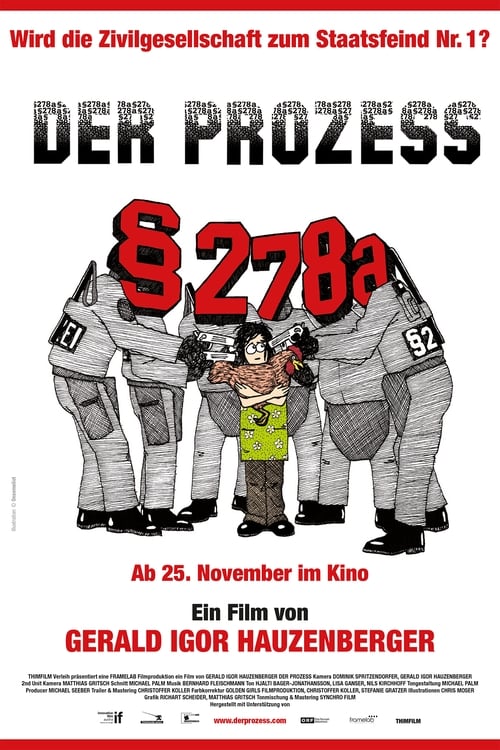
At 6am on May 21, 2008, armed police burst into the apartment of Austrian dog trainer and animal-rights activist Sabine Koch, arresting her. After three months in custody, Koch, together with 12 other animal-rights activists, went on trial. They were charged with being members of a criminal organisation and therefore breaching article 273a of the Austrian Penal Code, introduced in the wake of 9/11. The article’s intention is to allow the state to stifle terrorist activity. Years of observation, house searches, and undercover agents – the police left no stone unturned in its bid to prove the animal-rights activists’ guilt. The sobering result: five million Euros worth of investigation, no proof and a great deal of scepticism towards the Austrian justice system – and democracy itself.
2019
2012
2009

2011
2016
2019
2007
2006
No reviews yet. Be the first to share your thoughts on this movie!
Use the rating form above to leave a star rating and optional review.