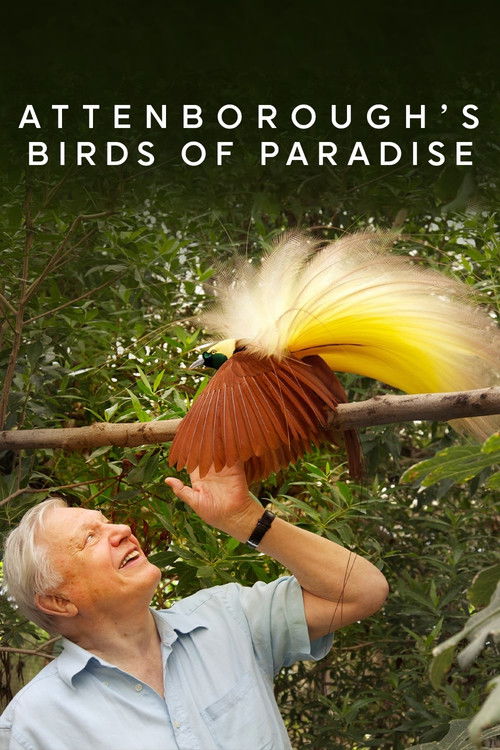
Birds of Paradise
2010
No user ratings available yet
Representation score: 3.7 out of 10

Representation Score
Minimal
1996
Director
Paul Reddish
Runtime
56 minutes
Average Rating
No ratings yetNew Showbiz Analysis
The film opens with David Attenborough’s voiceover recalling Alfred Russel Wallace’s 19th-century illustrations, framing the Papua New Guinea forest as a living archive of natural history. This opening establishes the film’s central argument: that the Western naturalist’s gaze is the necessary vessel for understanding and preserving the world’s biodiversity. The camera lingers on the intricate mating dances of the greater bird of paradise, treating the ecosystem as the true protagonist while local inhabitants appear as picturesque, silent figures in the background. The sold meaning is one of harmonious coexistence, where indigenous traditions like plume-hunting are acknowledged but ultimately subordinated to the global conservation narrative. Attenborough’s presence as the "competent observer" reinforces the hierarchy of Western scientific authority; he climbs the canopy to witness what Wallace could only imagine, positioning the European explorer as the ultimate arbiter of nature’s value. The film’s internal logic pulls apart when it celebrates the "pristine" state of the forest while ignoring the complex socio-economic realities of the people who live there. The ending settles on a solemn warning about environmental fragility, leaving the viewer with a sense of loss rather than resolution. The last image emphasizes the scale of the landscape and the smallness of human impact, reinforcing the idea that nature is a shared heritage to be protected by those with the knowledge to do so. While the film is visually stunning and effectively conveys the urgency of conservation, it relies on a traditional Western framework that treats non-Western cultures as part of the scenery rather than as active agents in the story of their own land.
Category Breakdown
The narrative focuses exclusively on ornithological behavior and ecological conservation. No same-sex intimacy, identity, or queer-coded dynamics appear in the footage or narration.
Local men are shown in traditional plume-hunting and wedding contexts, while women appear briefly in domestic or ceremonial roles without individual agency or voice.
Papua New Guinean inhabitants appear as background figures in plume-hunting and wedding scenes. They are framed as part of the "Paradise" landscape, serving the Western narrator’s conservation argument rather than possessing distinct political or cultural depth.
The film positions Western scientific observation as the moral lens for interpreting local traditions. Indigenous practices, such as using bird plumes as currency, are presented as charming but ultimately subordinate to the global ecological crisis, reinforcing the Western expert as the sole authority on nature’s value.
No characters with physical, sensory, or cognitive impairments are depicted. The focus remains strictly on healthy wildlife and able-bodied human observers.
Present on Screen
Limited or Absent
Official Synopsis
David Attenborough travels to the forests of Papua New Guinea, where 38 of the 42 kinds of bird of paradise are found.
2010

2015

2018

2002
2007
2019

2010

2018
No reviews yet. Be the first to share your thoughts on this movie!
Use the rating form above to leave a star rating and optional review.