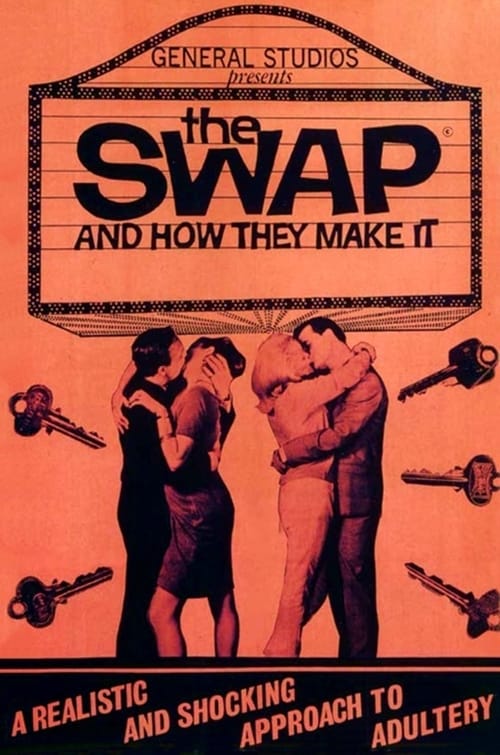
The Swap and How They Make It
1966
No user ratings available yet
Representation score: 4.8 out of 10

Representation Score
Limited
1970
XDirector
Kendall Stewart
Runtime
66 minutes
Average Rating
No ratings yetNew Showbiz Analysis
The film opens on a static, high-angle shot of a suburban living room, empty except for a glowing television, establishing the domestic vacuum before the characters enter. This image sells the American Dream as a sterile box, a premise reinforced by the painfully average phenotypes of the leads. The camera lingers on the wives’ faces with soft focus and warm lighting, treating them as the narrative subjects, while the husbands are shot from behind or in tight, uncomfortable close-ups that emphasize their awkwardness. The sold meaning is clear: the nuclear family is a cage, and the authentic, liberating space is the communal bond of female friends. The film’s argument is visual. The wives say they are unhappy, but the pictures show them enjoying each other’s company. The men say they are trying, but the pictures show them isolated and ineffective. Kay Gavin, the "supersexed entrepreneurial vixen," embodies this inversion, running the sexual exchange with a competence that the husbands lack. The film’s internal logic is consistent: the more perfect the home, the more unhappy the inhabitants. The irony is that the women’s happiness is found in the "imperfect" space of female friendship, not in the marital bond. The ending is the moral verdict. A wide shot of the group of women standing together in a park, smiling at the camera, their faces lit with artificial warmth, suggests a communal bond that replaces the failed domestic bonds. The men are not present. The joke is on the men, and the audience is asked to laugh with the women. The film treats the rejection of the husband’s authority as cost-free and morally superior. The women keep their status, their homes, and their dignity. The men bear the cost of the emotional labor deficit. The film’s argument is thin but consistent: male domestic presence is a burden, and female friendship is the authentic, liberating space.
Category Breakdown
Absent. All depicted intimacy is heterosexual; the "matinee tricks" involve straight couples swapping spouses under false names. No queer characters or themes appear on screen.
Present. The wives are the articulate moral center, while husbands are silent, interchangeable, and the running gag. Kay Gavin, a "housewife-turned-madam," runs the sexual exchange with entrepreneurial competence, inverting traditional domestic roles.
Absent. The cast is entirely white, middle-class, and suburban. No non-white characters appear; racial identity is unmarked and unexamined.
Present. The nuclear family is framed as an emotionally sterile cage, with the suburban home depicted as a hollow box. The film’s moral verdict favors female communal bonds over marital duty, treating traditional domesticity as a trap.
Absent. No characters display physical or cognitive impairments. The "illness" is purely emotional boredom, not medical or disability-related.
Present on Screen
Limited or Absent
Official Synopsis
Yes, totally bored with their husbands in bed, horny Hollywood-Hills housewives Linda Devlin and Pat Chandler have become Matinee Wives. For some time now, they’ve been turning "matinee tricks" with the horny hubbies of other frigid suburban housewives by housewife-turned-madam Kay Gavin, a supersexed entrepreneurial vixen who likes to "curl up with a warm vibrator" each morning to jump-start her day. So, of course, when Paul and Tom make plans for some "outside stud," who do you suppose they call? That’s right: the vibrant Madam Kay herself! And who do you suppose she sets them up with? Right again: each other’s wives! But the kicker is: no one knows this, neither the husbands nor the wives, as they’re all chipping under false names and no one has met the other’s spouse before! So all four are swapping partners and no one’s the wiser.
1966

1969
1970

1977
1968

1955

2006
1970
No reviews yet. Be the first to share your thoughts on this movie!
Use the rating form above to leave a star rating and optional review.