
Pecking Order
2017
No user ratings available yet
Representation score: 1.1 out of 10
Representation Score
Minimal
1948
Director
Jack Arnold
Runtime
18 minutes
Average Rating
No ratings yetNew Showbiz Analysis
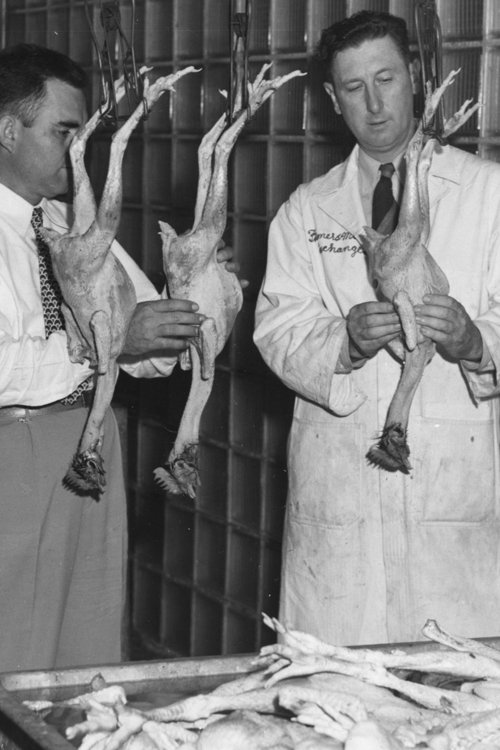
The Chicken of Tomorrow is a technical documentary focused on agricultural and industrial advancements in poultry farming. Its primary goal is to showcase scientific progress and efficiency, lacking character-driven social dynamics or diverse representation. The film adheres to the utilitarian storytelling conventions of the post-war era. It prioritizes production and resource management over social commentary or diverse representation. As a period-specific industrial document, the film reflects the homogeneous demographic norms of its time, offering little engagement with modern progressive representation metrics.
Category Breakdown
The film does not address gender identity or sexual orientation. It does not include characters with non-traditional gender identities or explore issues related to heteronormativity.
The film focuses on mechanical and biological processes typical of the era. It likely centers on a male-dominated technical perspective common in 1940s industrial media.
The film provides a specialized look at agricultural science within a mid-century Western industrial context. There is no indication of a diverse cast or narrative that challenges homogeneous demographic norms.
The narrative reinforces traditional Western industrial and capitalist frameworks. It celebrates technological progress and institutional efficiency without critiquing Western systems.
There is no evidence of characters or subjects with visible or invisible disabilities being integrated into the narrative or portrayed with significant roles.
Present on Screen
Limited or Absent
Official Synopsis
Advances in chicken and egg farming.
2017
1978
1938

1927
2000

2005
1959
2016
No reviews yet. Be the first to share your thoughts on this movie!
Use the rating form above to leave a star rating and optional review.