
Wir sind die Neuen
2014
No user ratings available yet
Representation score: 4.6 out of 10
Representation Score
Fair
2012
Director
Dietrich Brüggemann
Runtime
118 minutes
Average Rating
No ratings yetNew Showbiz Analysis
Move (2012) serves as a character study of a generation marked by transience. It dismantles traditional life milestones such as marriage or homeownership, substituting them with a focus on fluid social networks. However, the film lacks racial diversity, staying centered within a specific white European demographic. While it offers a nuanced exploration of identity and gendered vulnerability, it does not represent physical or neurodivergent disabilities. Ultimately, the film portrays urban alienation through shifting friendships rather than traditional societal structures.
Category Breakdown
The film delves into the protagonist's journey of discovering their sexual identity and self-discovery. It presents identity as a flexible process rather than a fixed state, challenging the idea that everyone is straight or cisgender.
The ensemble structure avoids rigid gender hierarchies by emphasizing interpersonal relationships and shared vulnerability over traditional masculine leadership.
The cast is primarily composed of white actors from European backgrounds, reflecting the specific social circles in Berlin. It does not significantly include non-Anglo-Saxon actors to challenge demographic norms.
The film questions traditional Western stability by highlighting transient social connections over permanent institutions. It depicts a postmodern existence characterized by constant movement and change.
There is no portrayal of specific physical or neurodivergent character arcs with real depth. The film focuses on psychological isolation and the struggle for belonging.
Present on Screen
Limited or Absent
Official Synopsis
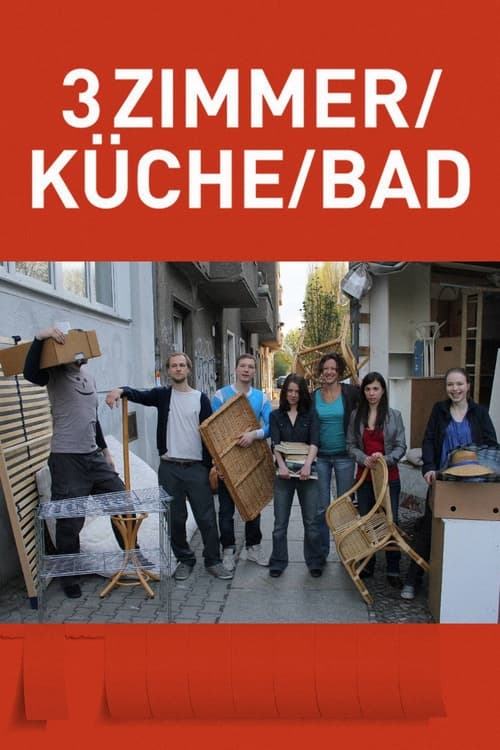
Eleven moving dates, eight friends: Philipp, Wiebke, Jessica, Maria, Swantje, Michael, Thomas, Dina – all in their twenties and mutually lonesome. And always searching: For a new city, a new job, an own apartment, a new, or even an old love. The search is never-ending, and so they repeatedly find themselves at a ritual gathering: someone moving. Boxes are shifted from one side of Berlin to the other, or the length and breadth of Germany, from one abode to the next as one life is exchanged for another. In 3 ZIMMER/KÜCHE/BAD, director Dietrich Brüggemann portrays existences in which relationships, social networks and backdrops are in a constant state of flux; where best friends are the only, and therefore the most valuable constant. Humorous sketches of the self-conception of a generation for whom moving has become the symbol of a life on the go.
2014
2012

2012
2001
2003

2001
2013
2019
No reviews yet. Be the first to share your thoughts on this movie!
Use the rating form above to leave a star rating and optional review.