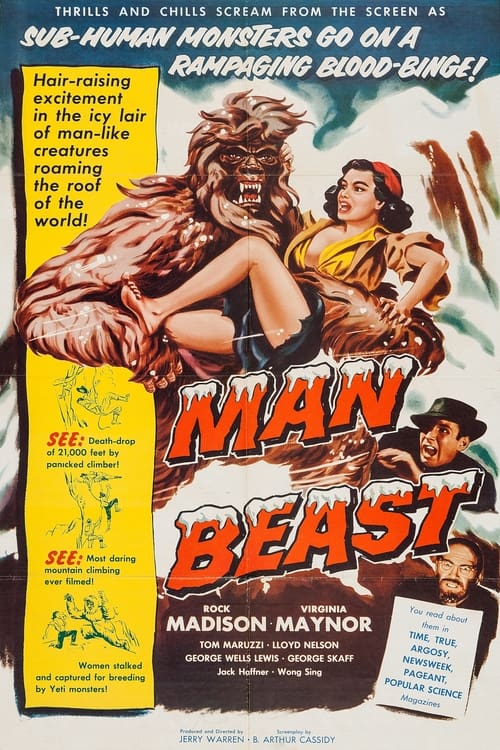
Man Beast
1956
No user ratings available yet
Representation score: 1.9 out of 10

Representation Score
Limited
1957
Director
Kenneth G. Crane, Ishirō Honda
Runtime
63 minutes
Average Rating
No ratings yetNew Showbiz Analysis
Half Human is a hybrid production that blends Eastern and Western cinematic sensibilities through the collaboration of Ishirō Honda and Kenneth G. Crane. While it moves beyond a purely Western setting by focusing on the Japanese Alps, the narrative remains rooted in mid-century clichés of scientific exploration and colonialist perspectives. The film's strength lies in its cross-cultural encounter, pitting modern scientific inquiry against indigenous worship. However, this interaction often reinforces a hierarchy where Western progress is the primary lens of truth. Ultimately, the film operates within the traditional social and cinematic hierarchies of its era. It lacks the complexity or subversion of power dynamics necessary to move beyond a standard adventure framework.
Category Breakdown
The film does not include any LGBTQ+ characters or narratives. It follows the standard social structures typical of 1957 cinema.
The story emphasizes masculine roles through scientists and explorers. Female characters are mostly relegated to secondary or domestic roles within this traditional hierarchy.
The film contrasts Western scientific perspectives with a remote Japanese tribe. This setup risks using 'othering' clichés common to mid-century adventure films.
A tension exists between secular science and indigenous spirituality. However, the narrative prioritizes a Western-centric view of scientific discovery over local beliefs.
There is no evidence of characters with visible or invisible disabilities in this production.
Present on Screen
Limited or Absent
Official Synopsis
An American scientist tells two colleagues about the finding of an abominable snowman living in the Japanese alps, where it is worshipped by a remote tribe as a god, and how it was discovered by modern man after it raided a skiers shelter following an avalanche, killing all inside. This is an adaptation of the Japanese film "Jūjin Yuki Otoko" (1955) with added American-made footage, narration, and music.
1956

1957

1954
1963

1959
1972
1971

1956
No reviews yet. Be the first to share your thoughts on this movie!
Use the rating form above to leave a star rating and optional review.