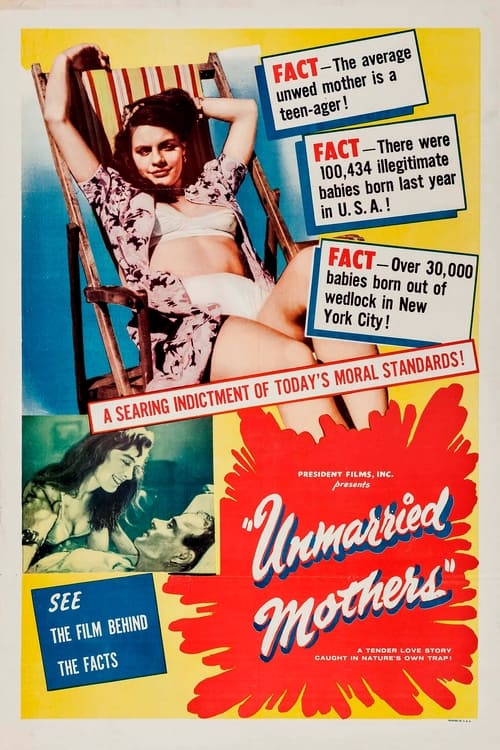
Unmarried Mothers
1953
No user ratings available yet
No diversity score available

1966
RDirector
Åke Falck
Runtime
105 minutes
Average Rating
No ratings yetSynopsis
The journalist Gunnar meets the cancer-patient Seija and love arises. Seija has only a short time left to live. The doctors advice her not to become pregnant, because radiotherapy could harm the fetus. She interrupts the radiotherapy and give later birth a healthy child. Meanwhile, it turns out that pregnancy has cured her cancer.
Overall Score
Fair
Category Breakdown
LGBTQ+ Representation
The story centers on a heterosexual romance between Gunnar and Seija. There is no visible presence of non-cisnormative identities or critiques of heteronormativity.
Gender Representation
Seija demonstrates significant autonomy by defying medical authority regarding her reproductive choices. Her decision to prioritize motherhood over clinical advice challenges traditional hierarchies of expertise.
Racial & Ethnic Diversity
The film appears to be a localized Swedish drama reflecting the homogeneous social structures of 1966. No evidence exists of a multi-ethnic cast or intentional racial blending.
Religious & Cultural Diversity
The narrative critiques institutional control by prioritizing subjective morality over scientific dictates. Seija’s choices suggest a lean toward moral relativism against traditional Western authority.
Disability Representation
Seija navigates a life-threatening cancer diagnosis with active agency. The film avoids passive victimhood, focusing instead on her resilience and decision-making regarding her own body.
Strengths
Areas for Improvement
AI Analysis
Prinsessan is a character-driven drama that finds its strength in the exploration of bodily autonomy. By centering the plot on a woman's defiance of medical institutions, the film offers a nuanced look at individual agency against systemic authority. However, the film lacks intersectional breadth. The narrative remains largely confined to a homogeneous Swedish social context, offering little representation regarding racial diversity or LGBTQ+ identities. Ultimately, while the film excels in portraying female resilience and the subversion of medical hierarchies, its narrow demographic scope limits its overall diversity impact.
1953
1952
1953
1946

1967

2010

1952

2009

2008

2016

2015

1967
No reviews yet. Be the first to share your thoughts on this movie!
Use the rating form above to leave a star rating and optional review.