
Berlin, I Love You
2019
No user ratings available yet
Representation score: 8.4 out of 10
Representation Score
Fair
2012
Director
Stefan Arsenijević, Hany Abu-Assad, Aida Begić, Iosifina Markarian, Stergios Niziris, Omar Shargawi, Eric Nazarian
Runtime
113 minutes
Average Rating
No ratings yetNew Showbiz Analysis
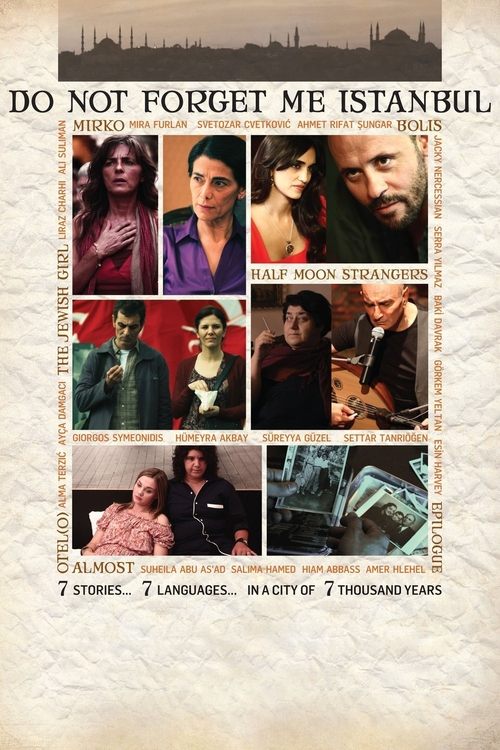
Do Not Forget Me Istanbul succeeds as a significant exercise in narrative decentralization. By employing a multi-national cohort of directors, the film moves away from a singular, Western-centric perspective to offer a polyphonic view of the city. The work's primary strength is its structural intentionality. It uses a fragmented, multi-layered approach to explore urban life, effectively reclaiming the city's history for a diverse regional audience. While the film excels in ethnic and cultural plurality, specific data regarding LGBTQ+ and disability representation remains limited. The strength lies in the overarching cinematic architecture rather than individual character archetypes.
Category Breakdown
The anthology's structure hints at a move away from the assumption that everyone is straight or cisgender. However, specific depictions of same-sex relationships or non-cisgender identities are not explicitly confirmed.
The ensemble format allows for a wide range of roles driven by women. By using multiple directors, the film avoids a singular, male-dominated viewpoint.
The film excels at breaking down the idea of a single ethnic or national identity. It portrays Istanbul as a complex, multicultural tapestry rather than a single ethnic or national group.
The premise challenges singular religious or nationalist stories. It promotes cultural pluralism by highlighting the interconnectedness of diverse lives and shared heritage.
There is no specific evidence regarding the portrayal of physical or neurodivergent disabilities within the film's narrative.
Present on Screen
Limited or Absent
Official Synopsis
Several directors from countries of the region were invited to create stories taking place in and around the beautiful city of Istanbul, in the vein of “Paris, je t’aime” and “New York, I love you”. They come together to remind viewers that Istanbul’s history does not belong only to the people of Turkey.
2019

1997

2008

1995
2014

1991

2014
2012
No reviews yet. Be the first to share your thoughts on this movie!
Use the rating form above to leave a star rating and optional review.